

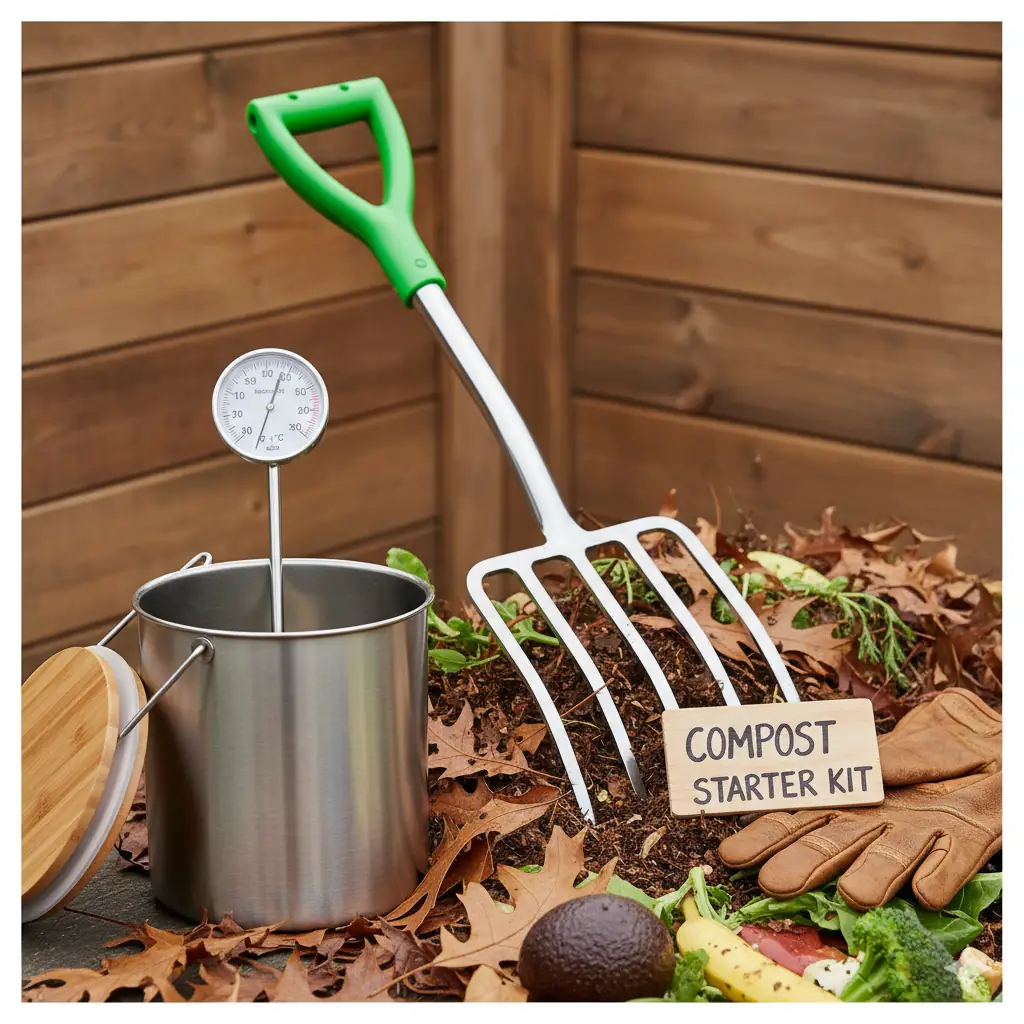

🌱 Starting Your Composting Journey Right
Composting might sound like a complex, scientific endeavor, but at its heart, it’s simply speeding up a natural process. It’s the ultimate form of recycling, turning kitchen scraps and yard waste—what we often call ‘trash’—into nutrient-rich soil amendment, affectionately known as ‘black gold.’
Many beginners think they need expensive, specialized gear, but the truth is, the essential tools are often simple, affordable, and readily available. Think of it like cooking: you don’t need a professional-grade kitchen to make a great meal, just a few key utensils.
This guide breaks down the core equipment that will set you up for success, ensuring your pile stays healthy, aerated, and on track to deliver beautiful finished compost.
🗑️ The Heart of the Operation: Composting Containers
Before you worry about turning or mixing, you need a place to hold your materials. The container is the foundation of your entire composting system, dictating size, location, and maintenance needs.
The Kitchen Caddy (The Indoor Start)
Every composting journey starts indoors, right in your kitchen. A small, sealed container—often called a kitchen caddy or scrap collector—is non-negotiable for convenient collection.
Look for one with a tight-fitting lid and a charcoal filter to keep odors at bay. This is your daily transfer station for coffee grounds, fruit peels, and vegetable trimmings, keeping them out of the landfill and ready for the main bin.
Outdoor Bin or Tumbler (The Main Event)
For the primary pile, you have two main choices: a stationary bin or a rotating tumbler. A stationary bin is the most budget-friendly option, often just a simple wire mesh cage or a repurposed plastic storage bin with air holes.
A compost tumbler is a barrel-shaped container mounted on a frame that allows you to easily spin the material. While more expensive upfront, tumblers make turning the pile incredibly easy and efficient, which is a massive benefit for beginners who might struggle with manual turning.
💨 The Must-Haves for Aeration and Mixing
A healthy compost pile needs air, much like humans need oxygen to survive. Without proper aeration, your pile will become dense, slow down, and turn into a smelly, anaerobic mess. This is where your mixing tools come in.
Compost Aerator or Turning Tool
This is arguably the most essential tool you’ll purchase. A dedicated compost aerator usually has a T-handle and an arrow-shaped or corkscrew tip that locks onto the material when pulled up.
It allows you to plunge deep into the pile and pull material from the bottom to the top, introducing air without requiring you to physically shovel the entire mass. It’s like using a whisk instead of stirring a bowl of batter with your hand—much more effective and easier.
Pitchfork or Shovel (For Larger Piles)
If you have a larger, open pile or a stationary bin, a sturdy pitchfork or a garden shovel will be necessary for a full, thorough turn. A pitchfork is preferable because the tines allow you to lift and shake the material, helping to break up clumps and introduce more air.
Using a pitchfork to turn the pile entirely—moving the outside material to the inside and vice versa—is the gold standard for consistent, hot composting, even if it requires more effort than a simple aerator.
💧 Measuring and Monitoring Tools
Composting involves balancing three main factors: ‘Greens’ (nitrogen), ‘Browns’ (carbon), and ‘Water.’ While Greens and Browns are material-based, water and heat require simple monitoring tools.
Watering Can or Hose Nozzle
Your compost pile should be consistently damp, similar to a wrung-out sponge. If it gets too dry, the microbes slow down or die; too wet, and it becomes a slimy, airless bog. A simple watering can or a hose nozzle set to a gentle shower is perfect for adding moisture when needed.
Compost Thermometer
To ensure your pile is actively ‘cooking’ and killing off weed seeds and pathogens, it needs to reach an internal temperature between $130^{\circ}\text{F}$ and $160^{\circ}\text{F}$ (about $54^{\circ}\text{C}$ to $71^{\circ}\text{C}$). A long-stemmed compost thermometer is the only way to confirm this.
It’s a simple diagnostic tool—if the temperature drops, it’s a sign that the pile needs more moisture, aeration, or a fresh injection of nitrogen-rich ‘Greens’ like grass clippings.
🛠️ Supporting Tools for Efficiency
These tools aren’t absolutely necessary to start, but they vastly improve the speed and quality of your finished compost, especially if you deal with a lot of yard waste.
Hand Pruners or Shredder
Composting works best when the starting materials are small. The smaller the piece, the more surface area the hungry microbes have to feast upon. Large branches or thick stalks will take years to break down.
You don’t need a huge, expensive wood chipper. A sturdy pair of hand pruners is great for snipping smaller branches, or you can run material like dry leaves over with a lawnmower to shred them before adding them to the pile.
A Reliable Pair of Gloves
While not a ‘composting’ tool, a comfortable and durable pair of waterproof gardening gloves is crucial. You’ll be dealing with everything from slimy food scraps to potentially sharp sticks and prickly yard trimmings.
Gloves keep your hands clean and protected, allowing you to confidently sift, turn, and handle the raw ingredients without worrying about getting dirty or injured.
💡 Design Highlight: The Two-Bin System
For gardeners planning to compost consistently, consider building or buying a Two-Bin System. This design involves two identical stationary bins side-by-side.
You fill Bin A with fresh scraps and material until it’s full. Once full, you stop adding to it and let it ‘cure.’ You then begin filling Bin B. By the time Bin B is full, Bin A will be finished compost, ready for use! This ensures a continuous supply of ‘black gold’ without mixing fresh and finished material.
✅ Quick Tips for Beginner Composting Success
- Start Small: Don’t build a massive pile on day one. A pile about 3 feet by 3 feet by 3 feet is manageable and heats up reliably.
- Balance: Always aim for a rough 2:1 ratio of Brown (dry leaves, shredded paper) to Green (food scraps, grass clippings) material.
- Chop: Break or cut all food scraps into pieces no larger than one or two inches. This dramatically speeds up the process.
- Keep it Damp: Squeeze a handful of material. If more than a few drops of water come out, it’s too wet; if nothing comes out, it’s too dry.
🌍 Beyond the Tools: The Microbe Factor
While these tools are your physical aids, remember that the real work is done by nature’s smallest, hardest workers: the bacteria, fungi, and invertebrates (microbes) that live inside your pile. Your job is simply to provide them with the perfect habitat.
By using your aerator regularly, keeping the moisture right, and monitoring the temperature with your thermometer, you are acting as the caretaker for this microscopic ecosystem. The essential tools aren’t just pieces of equipment; they are instruments of environmental management.
Embracing composting is a rewarding step towards a more sustainable lifestyle. Start with the basics, master the aeration, and you’ll soon be enjoying your own homemade, high-quality soil amendment. Happy composting!