


🌬️ The Essential Role of Aeration in Composting
Composting is often described as a recipe, but it’s just as much about managing a living ecosystem. In this ecosystem, turning the pile is arguably the most critical act of stewardship you can perform.
Turning achieves the crucial task of aeration, which introduces oxygen into the pile. Oxygen is the lifeblood for the aerobic microbes—the bacteria and fungi—that efficiently decompose your organic materials.
Without sufficient oxygen, these helpful microbes slow down or die off, giving way to anaerobic bacteria. This is what causes the foul, rotten-egg smell often associated with struggling compost piles.
Therefore, the question isn’t whether to turn your compost pile, but rather, finding the right frequency to match your composting goals and system.
🔥 The Speed Factor: Hot vs. Passive Composting
The frequency with which you turn your pile is directly linked to how quickly you want to produce finished compost. This creates a clear distinction between the two main composting philosophies: hot and passive.
The High-Intensity Approach: Hot Composting
Hot composting aims to generate and maintain high internal temperatures—typically between $130^{\circ}\text{F}$ and $160^{\circ}\text{F}$ ($54^{\circ}\text{C}$ to $71^{\circ}\text{C}$). This rapid breakdown is intensive but highly effective, often yielding compost in four to eight weeks.
To sustain these high temperatures, the microbes need a constant and ample supply of oxygen. This means frequent turning is non-negotiable, acting as a direct control mechanism for the entire process.
For hot composting, you should typically turn the pile every three to five days, or specifically, whenever the internal temperature starts to drop below the optimal range. The thermometer becomes your scheduling assistant.
The Low-Key Approach: Passive Composting
Passive composting, often used by those with less time or material, involves simply collecting scraps and yard waste and allowing nature to take its course. It doesn’t require consistent temperature monitoring or frequent effort.
In a passive system, you might only turn the pile once a month, or even less frequently, perhaps just when adding a new batch of material. The trade-off for this ease is time; compost may take anywhere from six months to two years to finish.
Passive piles rely on natural ventilation and slow decomposition. While minimal turning is fine, a few turns throughout the year will still significantly speed up the process compared to none at all.
🌡️ Reading the Temperature: The Best Guide
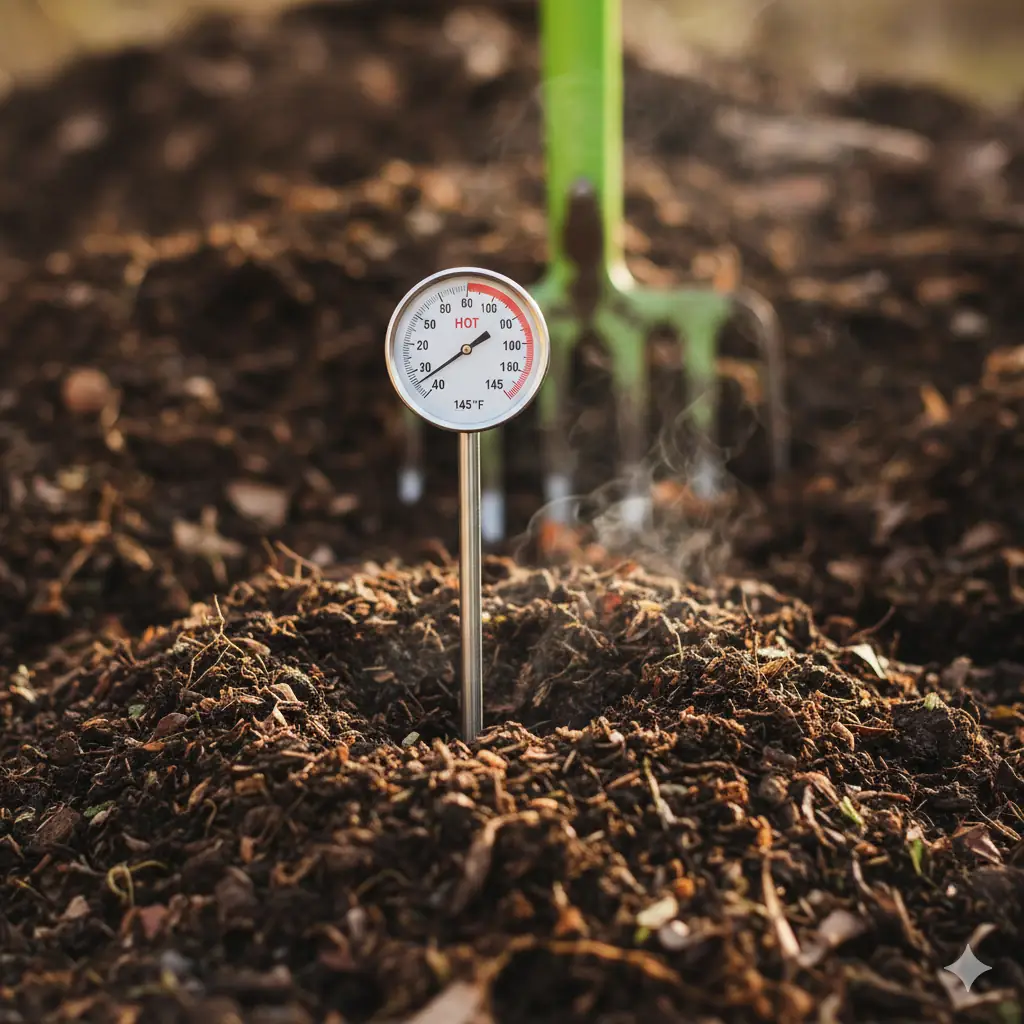
For those serious about making high-quality compost relatively quickly, the compost thermometer is the ultimate tool for determining turning frequency. It provides a data-driven approach rather than relying on an arbitrary schedule.
The Rise and Fall Cycle
When you turn a healthy, active pile, you introduce oxygen, which causes the microbial activity to spike. This microbial explosion leads to a rapid increase in temperature, often peaking within 24 to 48 hours.
Once the temperature peaks, it will gradually begin to drop as the accessible oxygen is used up. When the temperature falls below $130^{\circ}\text{F}$, it’s your definitive signal to turn the pile again, essentially ‘recharging’ the microbial engine.
This method ensures you are maximizing the heating cycle. Turning too early wastes energy, and turning too late means the pile has sat dormant, wasting time.
The Importance of a Long-Stem Thermometer
You need a thermometer that can penetrate to the center of your pile (ideally 12-18 inches) because the surface temperature is not reflective of the true internal activity. The core is where the highest temperatures—and the most intensive breakdown—occur.
Thoughtful Insight: The act of turning a pile not only reintroduces oxygen but also serves a vital second function: it thoroughly mixes the materials. This moves the less-decomposed outer layers to the hot, active center, ensuring a consistent and uniform finished product.
🪜 Practical Turning Schedules by System Type
The type of container you use will also influence how often you realistically *can* and *should* turn your compost.
Compost Tumblers
Tumblers make turning effortless, as you simply spin the barrel. Since aeration is so easy, there is a temptation to spin them daily. However, turning a tumbler too frequently (like daily) can actually cool the pile by constantly disrupting the heat pockets.
For a tumbler, it’s best to follow the temperature rule (turn when temperature drops) or adhere to a schedule of two to three times per week, ensuring the pile gets sufficient mixing without losing its core heat.
Traditional Three-Bin Systems
Three-bin systems are often used for batch composting and are conducive to hot composting. You move the entire mass from Bin 1 to Bin 2, and then from Bin 2 to Bin 3.
The turning frequency here is naturally spaced out by the batch process. Once Bin 1 reaches its target temperature and then cools, you turn the entire contents into Bin 2. This complete structural overhaul is typically done on a weekly or bi-weekly basis, depending on material volume.
Wire Cage or Open Piles
These require manual effort with a pitchfork or shovel. For beginners, a realistic goal is turning the pile thoroughly once every one or two weeks. Alternatively, if the pile begins to smell, treat that as an immediate signal that an emergency turn is required.
⚙️ Advanced Turning Tips for Efficiency
- Start with Structure: Always turn the pile *after* adding a significant volume of new ‘Green’ material to ensure it’s immediately mixed with ‘Browns.’
- Check for Moisture: Before turning, check the moisture content. If it feels dry, spray or sprinkle water during the turning process to help distribute moisture evenly.
- Listen to the Weight: If the pitchfork feels surprisingly light and crumbly, the composting is well underway. If it feels heavy and slimy, it urgently needs more aeration and dry ‘Brown’ material.
- Turn Completely: For the best results, aim to move the material from the outside edges of the pile into the center, fully inverting the contents to expose everything to the highest heat.
🎯 Finding Your Composting Rhythm
Ultimately, the perfect turning frequency is not a rigid number, but rather a dynamic response to the conditions within your pile. It’s about maintaining that sweet spot where air, heat, and moisture align.
Start by observing your pile. Use your thermometer, pay attention to the smell, and be willing to adjust your schedule. Once you learn to ‘read’ your pile, you will establish a natural, efficient rhythm that consistently delivers nutrient-dense compost for your garden.