


🌿 Transforming Your Lawn: Compost vs. Chemical Fertilizers
When most people think about fertilizing a lawn, they picture bags of bright granules. But that approach often feeds the grass temporarily without addressing the health of the underlying soil.
Compost offers a fundamentally different solution. It’s not just a nutrient supplement; it’s a soil conditioner that builds long-term vitality.
By using compost as your primary lawn fertilizer, you encourage deep root growth, improve water retention, and create a resilient turf that naturally resists pests and disease.
🔬 The Science of Compost for Turf
Compost’s power comes from its physical structure and its microbial diversity, qualities that bagged fertilizers can’t replicate.
Structure and Aeration
When spread over the lawn, compost filters down into the existing soil, breaking up compacted areas. This process, known as topdressing, increases aeration, allowing grass roots access to vital oxygen.
In heavy clay soils, it provides drainage channels, and in sandy soils, it acts like a sponge, helping the turf hold onto water and nutrients.
Slow-Release Nutrients
Compost provides nutrients like nitrogen, phosphorus, and potassium (N-P-K) slowly, as the remaining organic matter decomposes.
This steady feeding prevents the rapid growth spikes and subsequent crashes common with synthetic fertilizers, leading to much healthier, sustained growth.
📝 Preparation is Key: Quality Control
Before you even step onto the grass, you must ensure your compost is ready for the lawn. Using unfinished compost can actually harm your turf.
The Finished Product
Only use fully finished, cured compost. It should be dark brown or black, crumbly, and have a pleasant, earthy smell. You should not be able to identify any original food scraps or leaves.
Unfinished compost can tie up nitrogen in the soil, temporarily starving your grass. It also might introduce weed seeds if not heated properly.
Screening for Fine Texture
For lawn topdressing, the compost must be fine enough to fall easily between the blades of grass and settle onto the soil surface. Larger chunks will simply sit on top.
Run your finished compost through a fine screen (a ‘sifter’ or ‘trommel screen’) with 1/4 to 1/2-inch mesh. This removes any large sticks or clumps, ensuring a professional application.
📏 Application Technique: The Art of Topdressing
Topdressing is the process of spreading a thin layer of compost evenly over the existing turf. The key here is consistency and thinness.
Step 1: Mow Low and Aerate
A few days before application, mow your lawn slightly lower than usual. If your lawn is heavily compacted, consider aerating it first. The holes left by the aerator will act as perfect funnels for the compost.
Step 2: Calculate the Spread Rate
You don’t need a thick layer! The recommended rate for general lawn maintenance is about 1/8 to 1/4 inch of compost spread across the entire lawn surface.
A small amount goes a long way. Too thick of a layer can smother the grass and prevent sunlight from reaching the blades.
Step 3: Spread Evenly
You can spread the compost using a shovel or a mechanical drop spreader, but the goal is to make a lot of small piles across the area.
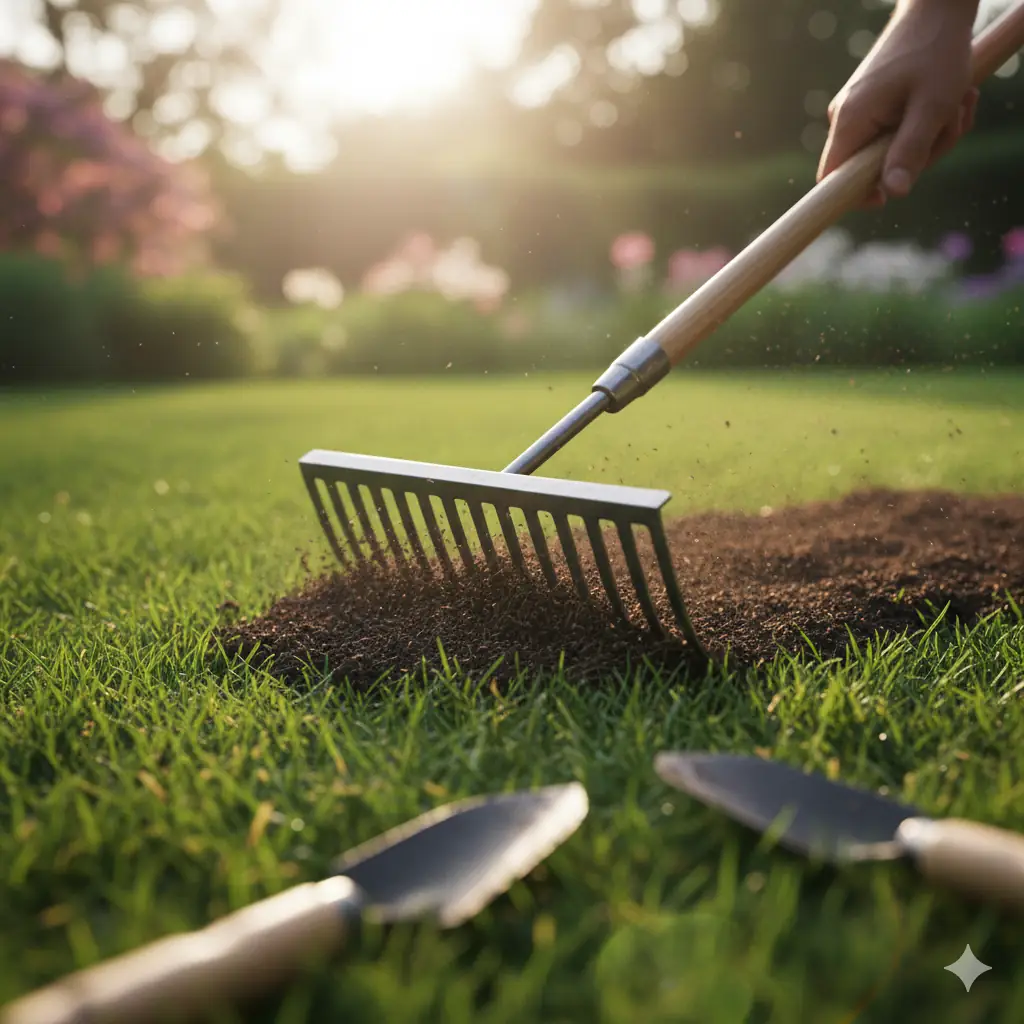
Then, use the backside of a heavy rake, a push broom, or a specialized topdressing drag mat to vigorously work the compost into the grass canopy until it disappears from view and settles around the root crown.
💧 Post-Application Care
Once the compost is spread and worked into the turf, your final steps ensure the process is successful.
Water In Immediately
Water the lawn lightly but thoroughly immediately after topdressing. This helps wash the fine compost particles off the grass blades and down into the soil where they can start conditioning the roots.
Frequency and Timing
For most lawns, a single application of compost topdressing per year is sufficient, typically done in the early spring to boost growth or in the early fall to build strength before winter dormancy.
Design Highlight: Lawn Health Scorecard
- Water Retention: Significantly improved due to organic matter.
- Nutrient Availability: Steady, slow-release feeding all season.
- Soil Structure: Gradually becomes looser and less compacted over time.
- Disease Resistance: Boosted by beneficial microbial colonies.
🌱 The Long-Term Payoff
While spreading chemical fertilizer provides instant green gratification, using compost is an investment in your lawn’s future. You are nurturing the entire soil ecosystem, not just the blades of grass.
Over time, a topdressed lawn will require less supplemental watering, less chemical intervention, and will naturally display better resilience against stress. It’s the smart, sustainable way to achieve a lush, healthy turf.