

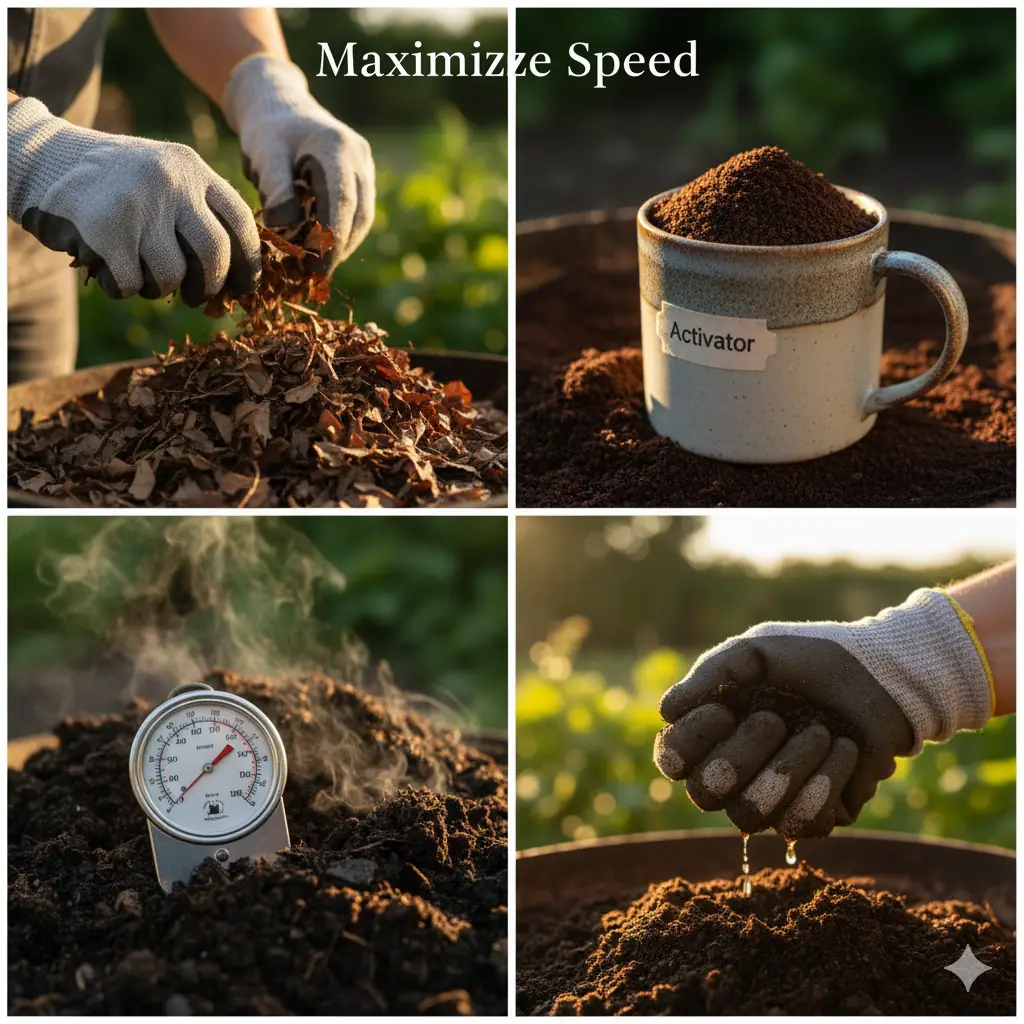

⏱️ The Need for Speed: Why Compost Takes Its Time
Waiting for compost to finish can feel like watching grass grow. While nature operates at its own pace, a slow compost pile often signals an imbalance in one of the core elements that fuel the decomposition process.
The speed of composting is directly linked to the happiness and efficiency of the microbial armies doing the heavy lifting—the bacteria, fungi, and actinomycetes.
By giving these tiny workers the ideal conditions, we can shift the process from ‘cold composting’ (slow) to ‘hot composting’ (fast), drastically cutting the turnaround time.
🔑 Lever 1: Size Matters (Maximizing Surface Area)
The single easiest way to speed up decomposition is to reduce the size of the materials going into your pile. Think of it as pre-chewing the food for the microbes.
Chop, Shred, and Grind
Microbes can only consume materials on the surface. A large piece of wood takes months, but shredded wood chips break down in weeks because the surface area is exponentially larger.
Always chop, shred, or grind bulky items like large fruit rinds, broccoli stalks, or paper/cardboard. Aim for pieces no larger than one or two inches.
Example: Instead of tossing a whole banana peel, tear it into four pieces. Instead of whole leaves, shred them with a lawnmower. This simple step cuts weeks off the process.
⚖️ Lever 2: Achieve the Golden Ratio (C:N Balance)
Decomposition requires a perfect diet: carbon for energy (Browns) and nitrogen for growth (Greens). The fastest piles maintain a Carbon-to-Nitrogen (C:N) ratio of approximately 30:1.
Fuel the Fire with Nitrogen
Nitrogen-rich materials act as activators, generating the heat needed for fast breakdown. If your pile is cold and slow, it needs more ‘Greens’.
Excellent activators include fresh grass clippings, coffee grounds, manure, and fresh food scraps. These get the microbial reproduction rate soaring.
If you add too many Greens, the pile will become anaerobic and smelly. Always cap these additions with a layer of dry Browns (shredded cardboard, straw) to maintain the 30:1 balance.
💨 Lever 3: Aeration (The Oxygen Infusion)
The fastest decomposition relies on aerobic (oxygen-loving) microbes. When the pile compacts, air is forced out, and slow, smelly anaerobic bacteria take over.
Turn It Often
Regular turning is your most important tool for speed. Aim to turn the pile every time the internal temperature drops below 130°F, or at least once a week.
Turning breaks up compaction, releases metabolic heat and gases, and floods the center of the pile with fresh oxygen, reigniting the decomposition.
Use Bulking Agents
Prevent compaction from the start by incorporating bulking agents—materials that create air pockets. Good options include wood chips, straw, or small, non-compacting twigs.
Quick Tip: The Hot Spot Check
If your pile is steaming when you turn it, your microbial crew is thriving. If there’s no heat, check your C:N ratio (add greens!) and aeration (turn!).
💧 Lever 4: Maintain Perfect Moisture
Microbes require water, just like any other living organism. Too dry, and they go dormant; too wet, and they drown (leading to anaerobic conditions).
The Wring Test
Your pile should feel like a wrung-out sponge—damp enough to hold its shape, but not so wet that water drips out when you squeeze it.
If the pile is too dry, water it thoroughly while turning. If it’s too wet, add absorbent dry Browns (paper, cardboard) and turn to mix.
| Element | Impact on Speed | Speed Solution |
|---|---|---|
| Material Size | Directly proportional to surface area. | Shred, chop, or blend all bulky items to 1-2 inches. |
| C:N Ratio | Drives heat generation and microbial reproduction. | Ensure 30:1 ratio; add nitrogen activators like coffee grounds. |
| Aeration | Required for fast aerobic decomposition. | Turn the pile 1–2 times per week and use bulking agents. |
| Moisture | Critical for microbial function. | Keep consistency like a wrung-out sponge; water dry piles. |
☀️ Lever 5: Location and Volume
Finally, external factors like location and the sheer size of your pile play a role in maintaining high heat and, therefore, high speed.
Heat Retention
Compost piles placed in sunny, sheltered spots (like against a south-facing fence) maintain a higher external temperature, which supports internal microbial heat.
Furthermore, a pile needs to be at least 3x3x3 feet (1 cubic meter) to achieve the necessary critical mass to generate and sustain high decomposition temperatures. Smaller piles rarely heat up quickly.
🚀 The Takeaway: Control the Engine
Compost decomposition is a dynamic chemical process, not a passive act of waiting. You are the conductor, and these five levers—size, balance, air, moisture, and mass—are the controls to the engine.
By making these small, manageable adjustments to your technique, you take control of the speed, transforming weeks of waiting into days of active, hot decomposition. You will be rewarded with finished compost much faster!