

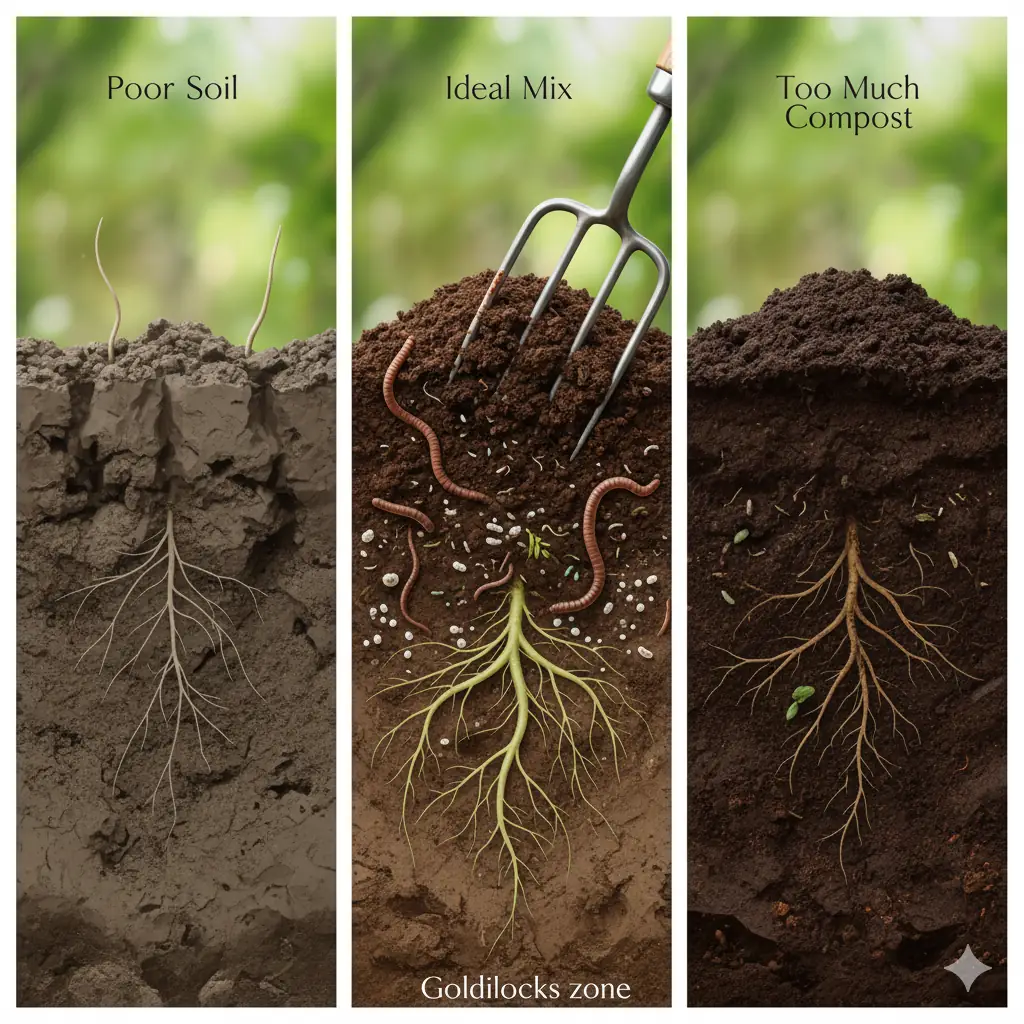

The Goldilocks Zone: How Much Compost to Add to Your Soil
Welcome to financeguru.me, your source for practical wisdom that helps everything grow—including your garden. Adding compost to your soil is arguably the single best thing you can do for plant health, but it raises a critical question: how much is enough? Like many things in gardening, the answer lies in finding the ‘Goldilocks Zone’—not too little, not too much, but just right.
Understanding the right ratio is crucial because compost is more than just fertilizer; it’s a powerful soil conditioner. Applying the correct amount ensures you reap all the benefits—improved structure, water retention, and nutrient supply—without creating new problems. Let’s explore the practical formulas for successful soil amendment.
The Role of Compost in Soil Health
Compost is often called “black gold” for good reason. It’s teeming with beneficial microorganisms and provides a slow, steady release of essential nutrients. When integrated into your garden, it actively transforms the physical, chemical, and biological properties of the soil.
Physically, it helps bind sandy soil particles to improve water retention, while simultaneously breaking up dense clay soils to enhance drainage and aeration. This balanced structure is exactly what plant roots need to thrive, ensuring they have access to both water and oxygen.
Why Moderation is Key
While beneficial, even compost can be overdone. Adding too much can lead to an excess of soluble salts or nutrients, which can actually burn sensitive plant roots, similar to over-fertilizing with synthetic products. Furthermore, excessive compost can create a light, fluffy environment that makes it difficult for some plants to anchor their roots.
The goal is always soil *amendment*, not replacement. We want to work the compost into the existing soil structure to improve it, not create a pure compost medium. Therefore, precision in application is a hallmark of professional-level gardening.
Calculating Compost for Garden Beds
For most typical garden applications, such as preparing annual vegetable beds or new flower borders, the standard recommendation is to target an application depth before mixing it into the soil. This is the simplest and most practical way for the average gardener to measure.
The ideal amount of compost to add for general soil improvement is usually a layer 2 to 4 inches deep spread evenly over the surface. This layer is then incorporated into the top 6 to 8 inches of your native soil using a tiller, garden fork, or shovel. This ratio ensures a perfect blend of native soil and organic matter.
Example: If you have a 100-square-foot garden bed (10 ft x 10 ft), a 3-inch layer of compost would require 25 cubic feet of material. This translates to roughly one cubic yard of compost for every 100 square feet, which is a key benchmark for gardeners buying in bulk.
Application Scenarios by Plant Type
Different plants and planting situations require slight variations in your compost application strategy. Understanding these nuances will help you fine-tune your approach for maximum impact.
- Annual Vegetable Beds: Apply 3–4 inches of compost and work it into the top 6–8 inches of soil every year before planting. Since vegetables are heavy feeders, this annual boost is essential.
- New Flower Beds: Start with a generous 4-inch layer, integrating it into the top 8 inches. This foundational amendment supports perennials and shrubs for many years.
- Established Perennial Beds: Use compost as a top dressing or mulch, applying a lighter 1–2 inch layer annually. Avoid digging it in deeply to prevent disturbing established root systems.
- Trees and Shrubs: Apply a 1–2 inch layer in a doughnut shape around the base, extending to the drip line, but never touching the trunk. This acts as a slow-release fertilizer and moisture retainer.
Compost and Specific Soil Types
The condition of your existing soil is the most important variable in determining your exact compost needs. Highly deficient or poorly structured soil requires a more aggressive approach than soil that already has a good amount of organic matter.
| Soil Type | Compost Application Strategy |
|---|---|
| Heavy Clay Soil | Use the maximum 4-inch layer and work it into 8 inches of soil. The carbon in the compost is vital for breaking up compaction. |
| Sandy Soil | Use a 3-inch layer worked into 6 inches. Compost is excellent here for retaining water and nutrients that otherwise leach quickly. |
| Loamy/Rich Soil | A maintenance dose of 1–2 inches applied annually is usually sufficient to maintain fertility and structure. |
The Importance of Soil Testing
For the most accurate assessment, a professional soil test is invaluable. It will tell you the current percentage of organic matter in your soil. Most experts recommend a target organic matter content of 3% to 5% for productive gardens.
If your soil test shows an organic matter level below 2%, you should definitely use the higher end of the 4-inch recommendation. This data-driven approach removes the guesswork, ensuring you apply exactly what is needed for optimal biological activity.
The Pro Insight: If you are adding compost to a lawn as a top dressing, use a very thin layer—no more than 1/4 to 1/2 inch—and rake it in well. This allows it to filter down to the root zone without smothering the grass blades.
Maintenance and Ongoing Application
Soil improvement is an ongoing process, not a one-time fix. Over the course of a growing season, compost is consumed by soil organisms and its nutrients are taken up by plants. Therefore, establishing a routine is important for sustained garden health.
For vegetable gardens that are constantly producing, an annual application is essential. For established perennial beds or shrub borders, a seasonal top-dressing or a lighter annual incorporation will keep the soil structure and nutrient levels high. A good rule of thumb is to apply compost when you see the soil beginning to look less rich and crumbly.
Compost Application Pros and Cons
- Pros: Improves soil structure dramatically, increases water retention, provides slow-release nutrients, enhances disease resistance, reduces need for chemical fertilizers.
- Cons: Can be labor-intensive to apply and incorporate, risks nutrient imbalance if overused, can introduce weed seeds if not properly screened, requires bulk purchasing or time to produce large volumes.
Concluding Your Strategy
Mastering the art of using compost is really about learning to observe your soil. Begin with the standard 2- to 4-inch guideline, adjusting based on whether you have heavy clay, loose sand, or already rich loam. Remember that integrating this organic material is an investment that pays dividends in plant vitality and reduced maintenance over time.
By finding that ideal “Goldilocks Zone,” you ensure that your garden receives not just food, but the perfect structural foundation it needs to flourish. Start small, observe the results, and you’ll quickly develop an intuition for exactly how much black gold your unique piece of earth requires.