

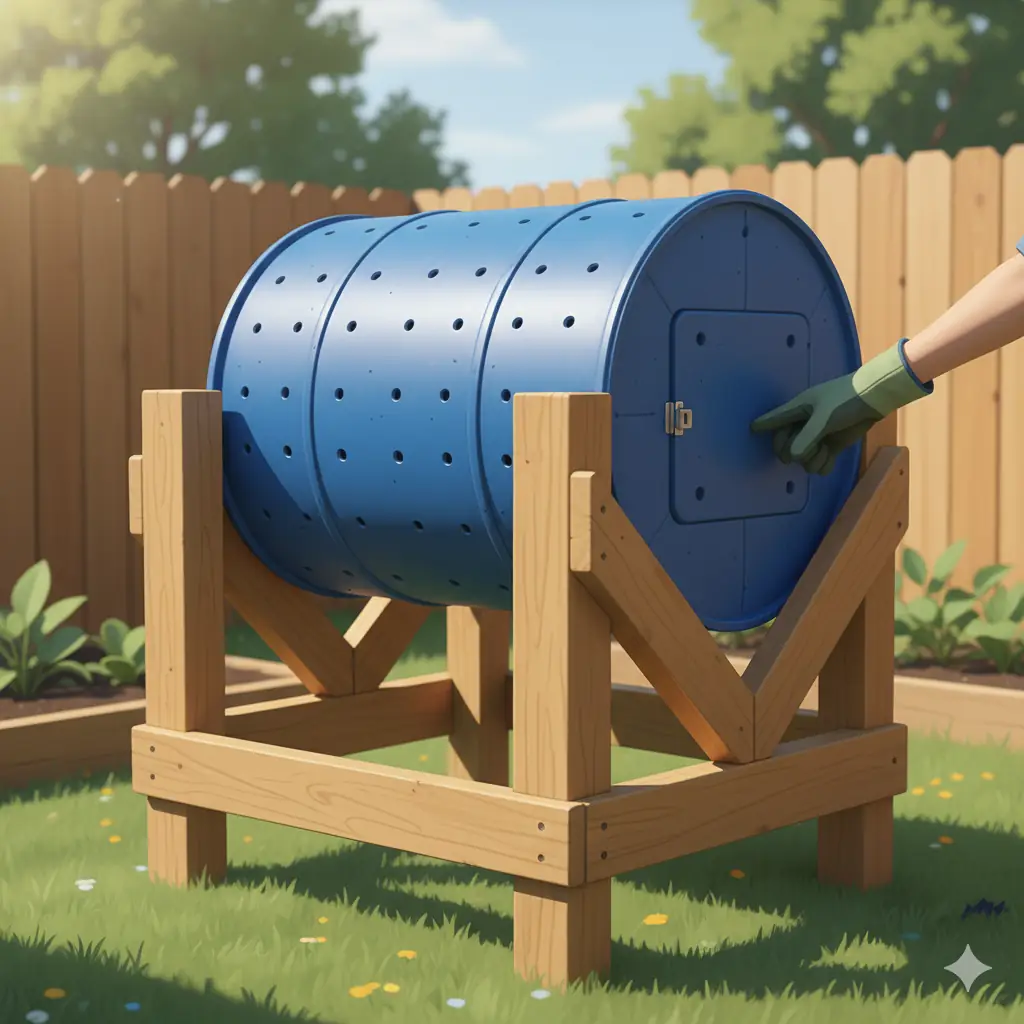

Composting is a core practice for sustainable living, but the traditional method—turning a pile with a pitchfork—can be quite a workout! If you’re looking for a low-effort, high-speed way to turn your kitchen and yard waste into ‘black gold,’ a compost tumbler is the answer.
A tumbler allows you to aerate your compost simply by giving the drum a few rotations, dramatically accelerating decomposition. Better yet, building one yourself is far simpler and cheaper than buying a pre-made commercial unit. Let’s get started!
Why Choose a Compost Tumbler?
While traditional stationary bins are certainly effective, tumblers offer several unique advantages that make them particularly appealing to many gardeners. They solve some of the most common composting challenges with a simple mechanical design.
Tumbler Advantages:
- Speed: Regular aeration is the key to fast composting. A tumbler makes it easy to turn the material every day, ensuring optimal oxygen levels and rapid decomposition.
- Pest Control: Since the composting materials are securely contained within a sealed barrel or drum that is elevated off the ground, pests like rodents are effectively kept out.
- Ease of Use: No more back-breaking pitchfork work! A simple turn of the barrel handles the heavy lifting, making composting accessible to everyone.
- Neatness: Tumblers are self-contained, preventing compost from spilling out and maintaining a tidy appearance in your yard or patio area.
Think of a traditional pile as slow-cooking stew that needs constant stirring, while a tumbler is a pressure cooker that handles the mixing for you, getting results much faster.
The Components: What You’ll Need
Building a basic, highly effective compost tumbler requires three main components: a durable barrel for the compost itself, a sturdy frame to hold the barrel, and an axle that allows the barrel to rotate.
Essential Materials:
- The Drum (The Heart): One large, food-grade plastic barrel (30-55 gallons) or a very sturdy plastic tote. Crucially, ensure it has never held toxic chemicals. A recycled plastic drum that once held syrup or non-toxic liquids is ideal.
- The Axle (The Spine): A long, strong metal pipe or steel conduit (approximately 1 inch in diameter) that will run through the center of the barrel.
- The Frame (The Support): Lumber (e.g., 4×4 or 2×4 treated wood) or sturdy metal piping to build the rectangular frame that supports the axle.
- Hardware: Heavy-duty bolts, locking nuts, lag screws, and two swivel caster wheels or flanges to hold the axle in place on the frame.
Safety Note: Always choose food-grade plastic barrels or containers. While composting materials can be dirty, you want to ensure the vessel itself doesn’t leach any harmful residues into your soil amendment.
🛠️ Step-by-Step: Building the Tumbler
This process breaks down into preparing the barrel, building the supportive frame, and assembling the rotating system. Take your time and measure twice to ensure everything fits securely.
Phase 1: Preparing the Barrel
- Clean Thoroughly: Wash the barrel inside and out, scrubbing away any residue. Let it dry completely.
- Drill Ventilation Holes: Using a 1/2-inch to 1-inch drill bit, drill numerous holes (30-50, spaced evenly) around the entire surface of the barrel. These holes are absolutely critical for oxygen to reach the compost and prevent anaerobic (smelly) decay.
- Cut an Access Door: Draw a large square or rectangle (about 12 inches by 12 inches) on the side of the barrel, near the top edge. Cut three of the four sides with a jigsaw, leaving one side attached to act as a hinge. Add simple latches or straps to secure the door firmly closed.
- Drill Axle Holes: Drill a hole slightly larger than your metal pipe (axle) directly through the exact center of both the base and the lid (or opposite sides) of the barrel. Accuracy here is vital for smooth rotation.
Phase 2: Building the Frame
The frame must be wide enough to allow the barrel to spin freely and tall enough so the door clears the ground when the barrel rotates. Treated wood is highly recommended for longevity outdoors.
- Cut Lumber: Cut the wood into four upright legs and four cross-beams (two long, two short) to form two identical rectangular end pieces. The height should ensure the barrel clears the ground by several inches.
- Assemble End Pieces: Assemble the two end pieces (the squares or rectangles) using strong bolts or deck screws. Ensure they are perfectly square for stability.
- Connect and Brace: Use the remaining two long beams to connect the two end pieces, creating a sturdy table-like structure. Add diagonal bracing to the legs if the frame feels wobbly—stability is key when the barrel is full and heavy.
Phase 3: Assembly and Rotation
This is where your composter comes to life! We need a mechanism for the axle to spin smoothly within the wooden frame.
- Secure Axle Holders: Attach two axle holders (either metal flanges or heavy-duty caster wheels with the wheel removed) to the inside top of the two long frame sides. The height should align perfectly with the hole in the center of your barrel.
- Insert and Lock the Axle: Slide the metal pipe (axle) through one of the barrel holes, across the center of the barrel, and out the other side. Center the barrel on the axle.
- Mount the Barrel: Gently lift the barrel/axle assembly and rest the axle ends into the designated holders on the frame. Use set screws or cotter pins outside the frame holders to prevent the axle from sliding side-to-side.
If you’ve measured correctly, your barrel should spin smoothly with a gentle push. Now you have a perfectly working, heavy-duty composter!
Using and Maintaining Your Tumbler
The beauty of a tumbler is that it makes the hardest part—turning—easy. Just remember to maintain the proper balance of materials and moisture, and you’ll be swimming in compost quickly.
- Balance: Aim for a 2:1 ratio of Browns (carbon-rich, dry leaves, shredded cardboard) to Greens (nitrogen-rich, kitchen scraps, grass clippings).
- Moisture: Keep the contents damp, like a wrung-out sponge. If it’s too dry, decomposition stops; if it’s too wet, it gets sluggish and heavy.
- Turn Daily: Give the tumbler 5–10 rotations daily. This is quick, easy aeration that dramatically speeds up the process and prevents odors.
Once the material inside is consistently dark, crumbly, and smells like fresh earth, you know your ‘black gold’ is finished and ready to enrich your garden beds. Happy tumbling!