


🚀 Starting Your Journey: Navigating the Beginner Traps
Composting is fundamentally simple—it’s just speeding up a natural process. Yet, it’s surrounded by common mistakes that often leave beginners frustrated with slow results, bad smells, or unwanted pests.
These missteps usually stem from misunderstanding the fundamental needs of the tiny microbes doing the work: air, a balanced diet, and water. Think of it like baking; a few wrong measurements can throw off the whole recipe.
By learning to recognize and avoid these pitfalls early on, you can ensure your first compost pile is a success story, not a stinky headache. Let’s look at the seven most common errors.
🛑 Mistake 1: Ignoring the Carbon-Nitrogen Balance
This is the most frequent cause of problems. Compost thrives on a balanced diet of ‘Greens’ (nitrogen, like food scraps) and ‘Browns’ (carbon, like dry leaves).
The Green Overload
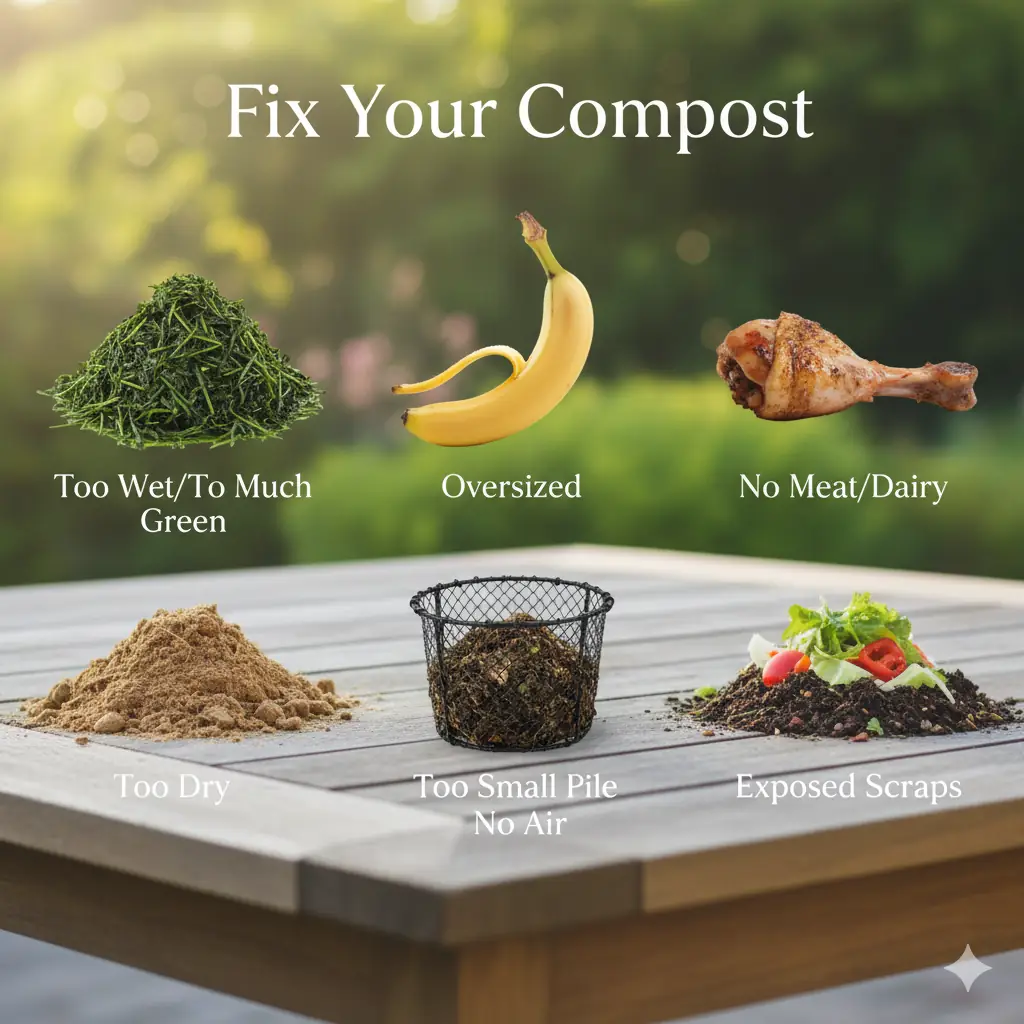
Beginners often add too many Greens, especially fresh grass clippings or a large amount of fruit waste. This imbalance leads to excess nitrogen, causing the infamous ammonia smell as the nitrogen escapes as gas.
The Fix: Always add 2 to 3 times the volume of dry Browns (shredded cardboard, dry leaves) for every one part of Greens you introduce. This keeps the diet balanced and prevents odor.
💧 Mistake 2: Getting the Moisture Wrong (Too Wet or Too Dry)
Decomposition halts if the pile is too dry, and it goes anaerobic (air-starved) and slimy if it’s too wet.
The Soggy Mess
A pile that is too wet eliminates the air pockets, allowing smelly bacteria to take over. This often happens in bins without proper drainage or when too many wet food scraps are added at once.
The Fix: The pile should feel like a wrung-out sponge. If it’s too wet, add handfuls of dry, absorbent Browns (like sawdust or shredded paper) and turn the pile to mix them in and introduce air.
🔪 Mistake 3: Adding Oversized Materials
Compost microbes can only eat materials from the surface. A large item, like a whole apple or a thick branch, takes exponentially longer to break down than a small one.
The Fix: Always shred, chop, or tear materials before adding them. Aim for pieces no larger than one or two inches. This maximizes the surface area, giving the microbes faster access to the food and speeding up the process by weeks.
🥩 Mistake 4: Composting High-Risk Materials
While almost all plant matter can be composted, beginners sometimes add items that attract large pests (rodents) or create severe odors in cold, home setups.
The Fix: Strictly avoid meat, bones, dairy products, and oily/fatty foods in traditional bins. These items rot slowly, attract scavengers, and create persistent, foul smells that compromise your whole setup.
💨 Mistake 5: Neglecting Aeration
Many beginners treat composting as a passive dumping ground. If the pile is not turned, it settles, compacts, and starves the beneficial aerobic microbes of oxygen.
The Fix: Turn your compost pile regularly—ideally, once a week, or at least every time you add a large batch of fresh, wet ‘Greens’. If your compost is cold and smells bad, immediate turning is the essential remedy.
🙈 Mistake 6: Leaving Food Scraps Exposed
Leaving fresh, exposed food scraps on the surface of the pile is an open invitation for fruit flies and other small pests, and it’s the primary source of initial bad smells.
The Fix: Always bury fresh kitchen scraps. Dig a small trench, dump the scraps, and immediately cover them with a thick layer (at least 6 inches) of dry, fluffy ‘Browns’ or finished soil. This smothers the smell and prevents pests from landing.
📏 Mistake 7: Starting with Too Small a Pile
A small pile, especially in cooler weather, cannot generate or retain enough heat to decompose quickly. It will simply sit there and cold compost very slowly.
The Fix: Aim for a minimum size of approximately 3 feet by 3 feet by 3 feet (1 cubic meter). This critical mass is necessary for the microbial activity to self-insulate and create the high temperatures needed for efficient, fast composting.
✅ Focusing on the Fundamentals
Composting success isn’t about complexity; it’s about consistency. If you master the simple fundamentals—balance your Browns and Greens, chop your materials, and ensure regular aeration—you will bypass all these common beginner mistakes.
By keeping those aerobic microbes happy with air, water, and a balanced diet, your reward will be continuous batches of odorless, rich, and healthy compost for your garden.