

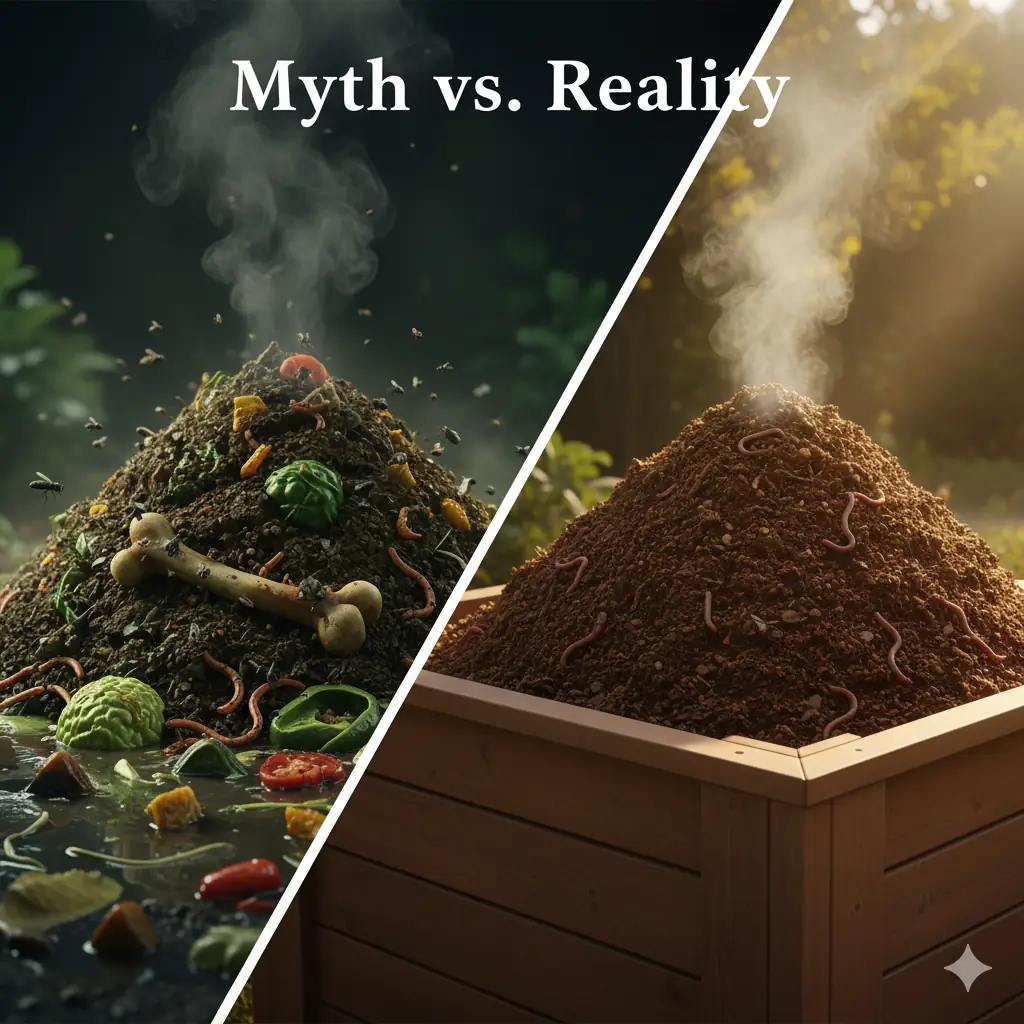

🔍 Fact vs. Fiction: Why Composting Gets a Bad Rap
Composting is a natural, simple process, but it’s surrounded by many enduring myths that confuse beginners and sometimes even frustrate seasoned gardeners. These misconceptions often lead to unnecessary worry or, worse, failure.
Many of these myths stem from old practices or simple misunderstandings about the microbial science at work. It’s time to set the record straight and simplify the process for everyone.
By understanding what’s truly necessary and what’s just folklore, you can approach your compost pile with confidence and achieve better results faster. Let’s start debunking!
🛑 Myth 1: Composting Always Smells Bad
This is perhaps the most common myth and the primary reason many people hesitate to start. A healthy, actively working compost pile should never smell foul. It should smell earthy, like wet soil or the forest floor.
The Reality: A bad odor—usually ammonia or rotten eggs—is not normal; it’s a symptom. It means your pile is suffering from an anaerobic condition, likely due to a lack of air (compaction) or an imbalance of materials (too much nitrogen/greens).
The fix is simple: add more dry carbon materials (browns) like shredded leaves, and turn the pile vigorously to introduce oxygen. Bad smells are a signal, not an inevitability.
🍊 Myth 2: Citrus Peels and Acidic Foods Will Ruin the Compost
Many old guides caution against adding citrus, tomatoes, or other acidic fruits because they are supposedly harmful to the microbes or will acidify the finished compost.
The Reality: While large amounts of citrus can temporarily increase acidity, the microbial community in the compost is extremely resilient. The composting process, especially the high heat phase, naturally buffers and neutralizes any high acidity.
You can safely add citrus rinds and tomato scraps in normal kitchen quantities. The only real concern is that excessive amounts might slow down the worms if you are vermicomposting, but for regular bins, they are fine.
💨 Myth 3: You Must Turn the Pile Every Single Week
The recommendation to turn weekly often intimidates beginners, suggesting that composting requires high maintenance and constant physical labor.
The Reality: Turning is essential for hot composting to speed up the process and control temperature, but it’s not a strict weekly rule. The real goal is to turn the pile whenever it starts to cool down or when you add a large batch of ‘greens’.
If you are using the ‘cold’ (passive) method, you barely need to turn it at all—it will just take much longer. Turning is about aeration and management, not a calendar obligation.
🧪 Myth 4: Coffee Grounds Make the Compost Too Acidic
Since coffee itself is acidic, many assume that used coffee grounds will make the finished compost acidic and harm plant life.
The Reality: Used coffee grounds are actually near-neutral in pH (around 6.5 to 6.8). The brewing process extracts most of the acid. They are primarily a strong source of nitrogen (greens), not acid.
They are excellent compost activators. The only caveat is that they must be mixed in well, as a thick, unmixed layer can compact and restrict airflow, causing problems unrelated to pH.
🥩 Myth 5: You Can Never Compost Meat or Dairy
The rule of avoiding meat and dairy is widely taught, making people think these items are universally toxic to the pile. This isn’t entirely true.
The Reality: The main reason to avoid meat, dairy, and oily foods in a traditional compost bin is to deter pests (like rodents and raccoons) and to prevent bad odors in cold, slow piles.
If you use an advanced, sealed system like Bokashi (which ferments waste) or maintain a very large, actively hot pile (reaching over 140°F), these items can be processed safely. For most home composters, however, the risk/reward ratio makes avoidance the simplest rule.
✨ Dispelling the Myth: Compost Heating
Fact: Achieving high heat (130°F–160°F) is not necessary for decomposition; it’s necessary for speed and killing weed seeds/pathogens. Cold composting works fine, just slowly.
🎯 Putting Misconceptions Aside
Composting is fundamentally a flexible process driven by nature. The rules are less about strict adherence and more about supporting the microbial community.
If your pile is not smelly, not attracting pests, and the volume is reducing, you are doing it right, regardless of what you read in a rigid textbook.
By focusing on the core principles—balancing carbon (browns) and nitrogen (greens), maintaining moisture, and ensuring plenty of air—you can confidently ignore the myths and enjoy the simple, rewarding process of turning waste into soil.