

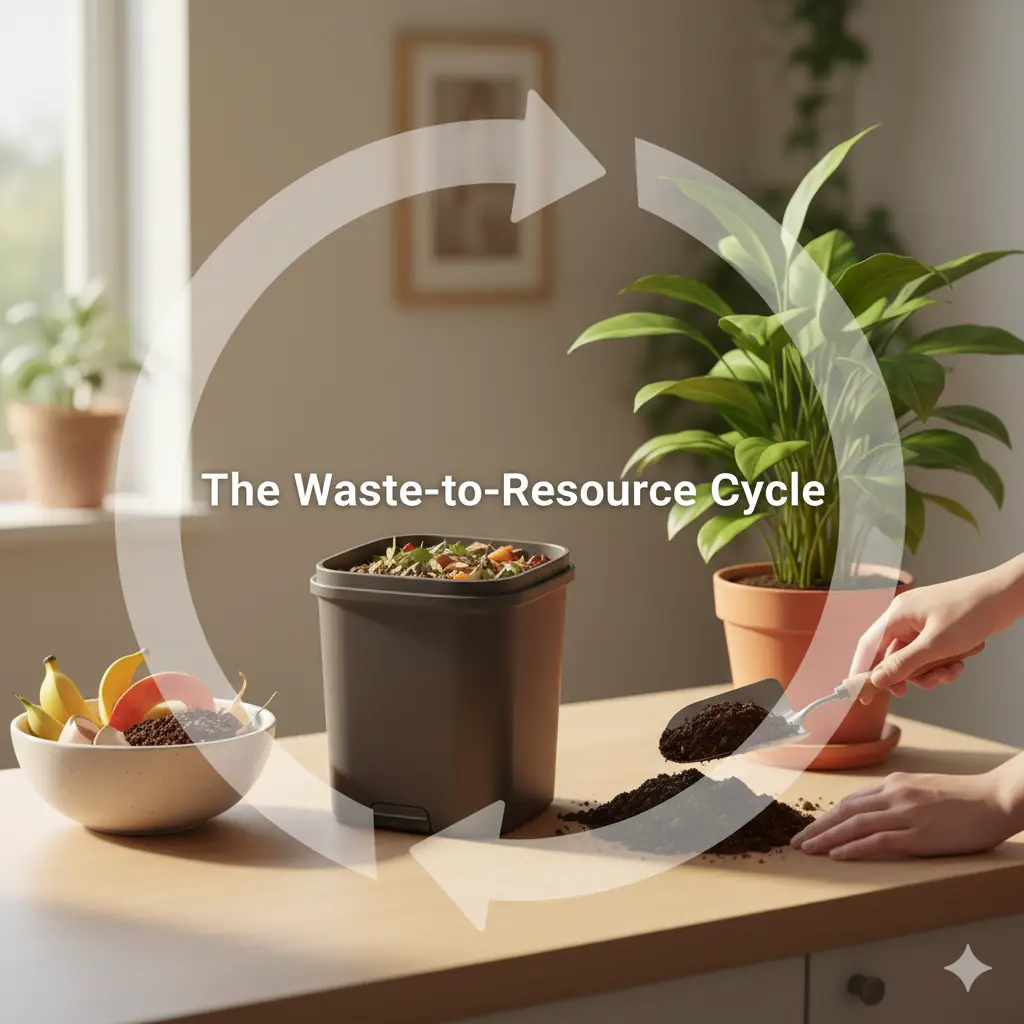

🗑️ The Surprising Bulk of Our Trash: Organic Waste
When you picture your weekly garbage bin, what do you see? Often, we focus on plastics and packaging, but a huge portion of what goes to the curb is actually organic material.
Food scraps, yard trimmings, coffee grounds, and paper towels collectively form the single largest component of municipal solid waste (MSW) in many areas.
This organic bulk is the core opportunity for massive household waste reduction. By composting, we intercept these materials before they ever reach the landfill, transforming them into a valuable resource.
The Landfill Problem: Anaerobic Decomposition
The issue with organic waste in a landfill isn’t just about space; it’s about what happens when it breaks down without oxygen. This process is called anaerobic decomposition.
When food scraps decompose anaerobically, they generate methane, a potent greenhouse gas that is far more effective at trapping heat in the atmosphere than carbon dioxide over the short term.
Composting, conversely, is an aerobic process—it uses oxygen. This means the organic matter breaks down into stable carbon compounds and water vapor, bypassing the methane generation stage entirely.
The Immediate Impact: Diversion Statistics
Starting a composting routine offers immediate, tangible results right inside your own home. You will literally see your garbage can empty slower and less often.
For the average American household, anywhere from 20% to 50% of their waste stream is compostable. That’s up to half of your trash volume disappearing overnight!
Calculating Your Personal Waste Reduction
Imagine your trash can is half-full before you even add non-recyclables or plastics. Composting those materials means you have effectively doubled your landfill diversion rate just by dealing with organics.
This reduction is not only great for the planet, but it can also translate into practical savings. Less trash often means you can opt for smaller bins or less frequent municipal pickup services, saving on annual fees.
Consider this illustrative comparison: Tossing a bucket of banana peels and vegetable ends is waste. Turning that bucket into rich, dark soil is resource creation.
💡 Design Highlight: The Zero-Waste Loop
Composting completes the natural cycle: food comes from the earth, and its remnants return to the earth to create more food. This closes the loop that industrial waste management breaks.
This sustainable design principle—using the ‘waste’ product as an input for the next cycle—is foundational to regenerative systems and true zero-waste living.
Beyond the Bin: Supporting Soil Health
Waste reduction is the primary goal, but the resulting compost has a second, equally important function: regenerating soil. This is where the long-term environmental benefits shine.
Finished compost is a powerful soil amendment that improves structure, increases water retention, and provides vital micronutrients.
Decreasing Reliance on Commercial Fertilizers
When you use your own compost in your garden or potted plants, you reduce the need to purchase synthetic fertilizers. These commercial products rely on energy-intensive manufacturing processes.
Furthermore, relying on local compost prevents the runoff associated with synthetic fertilizers, protecting local waterways from nutrient pollution and eutrophication.
It’s a circular economic model: your waste becomes your wealth, decreasing your spending and environmental footprint in the process.
Handling the Input: What Goes In and Why
Understanding what materials are ideal for composting helps maximize your waste reduction potential. The goal is to balance ‘Greens’ (nitrogen-rich) and ‘Browns’ (carbon-rich).
High-Value Household Compostables
The ‘Greens’ typically include fruit and vegetable scraps, coffee grounds, and tea bags. These break down quickly and are the source of most nutrients.
The ‘Browns’ are essential for structure and air flow and include shredded paper, cardboard (remove tape), egg cartons, and dried leaves. These absorb excess moisture and prevent compaction.
By balancing these two types of materials, you ensure an efficient, odor-free decomposition process, which is critical for maintaining an easy and continuous waste diversion system at home.
Scaling Up: Community and Regional Impact
While one household composting is great, the true power of this practice emerges when scaled up. Community composting programs and municipal collection services multiply the impact.
The success of large-scale organics programs in cities like San Francisco demonstrates that effective policy can divert millions of pounds of methane-generating material from landfills every year.
The Economic Argument for Organics Recycling
For municipalities, the cost of transporting and landfilling heavy organic waste is significant. Organics collection and composting can be a more cost-effective management strategy over time.
Furthermore, the sale of the finished compost product creates a revenue stream, turning a costly disposal problem into a sustainable resource business.
As individuals, choosing to compost supports this economic shift, helping to make organics recycling the normalized, preferred method for managing household food waste.
Ultimately, composting is one of the most powerful, straightforward actions you can take to make a meaningful dent in your household’s environmental footprint. It moves us from a linear ‘take-make-dispose’ model to a restorative, circular one.