

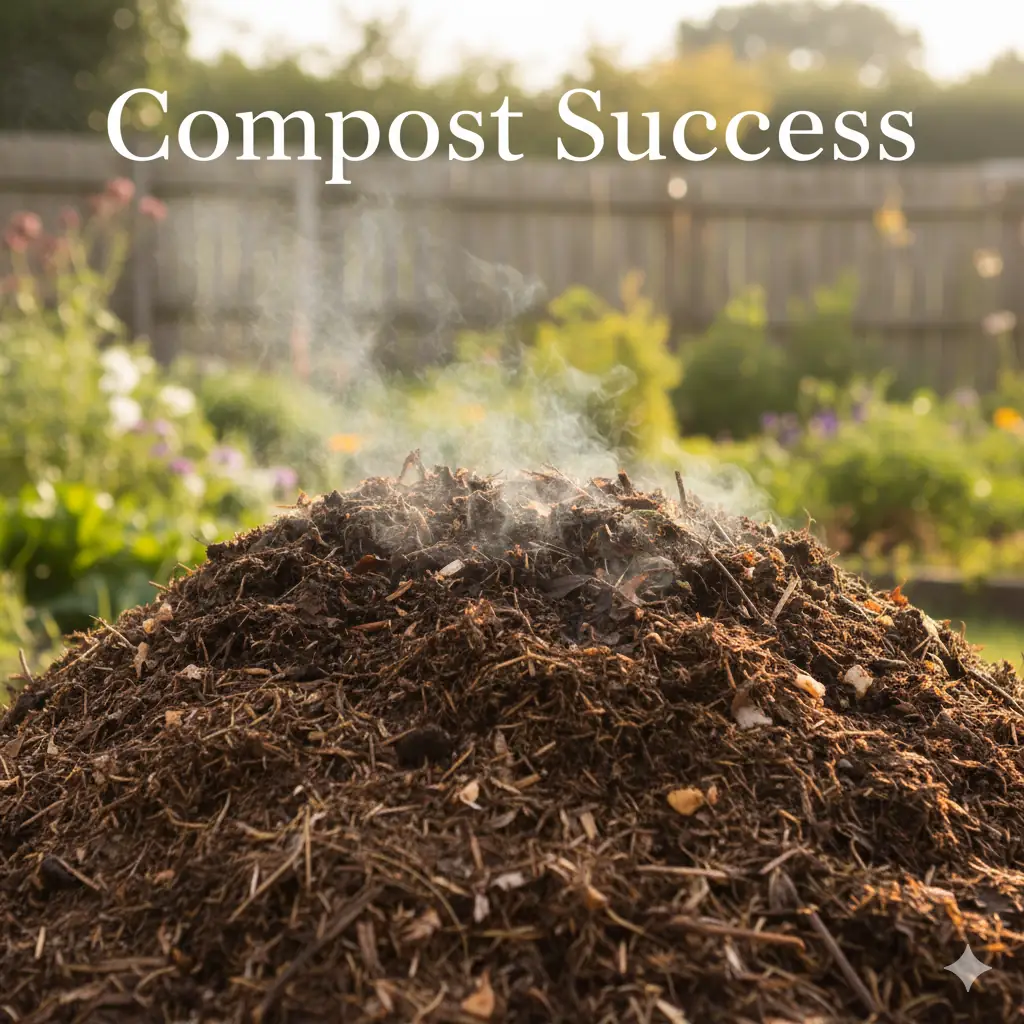

🌱 Why Isn’t My Compost Cooking? The Core Issues
There’s nothing quite as satisfying as a properly managed compost pile. It’s the ultimate act of recycling, transforming kitchen scraps and yard waste into nutrient-rich ‘black gold’ for your garden.
However, when your pile starts moving slower than a snail on a rainy day, that feeling of satisfaction quickly turns to confusion. A healthy compost pile should be heating up—a sign that the microbial engine is running strong.
But don’t worry, a slow or stalled pile is almost always easy to diagnose and even easier to fix. It usually boils down to an imbalance in one of the three key ingredients: air, water, or food.
Let’s dive into the five most common culprits and the practical steps you can take today to get your heap back up to temperature.
💧 Issue 1: Moisture Imbalance (Too Wet or Too Dry)
The microbial life responsible for decomposition is incredibly sensitive to moisture. Think of your compost pile as a damp sponge; it needs to be moist, but never soaking wet or bone dry.
If your pile is too dry, microbial activity stops altogether—it’s like a drought in the microbe world. If it’s too wet, the water fills the tiny air pockets, leading to anaerobic (oxygen-less) conditions, which causes the pile to cool and become smelly.
The Fix: The Squeeze Test
The simplest way to check is the ‘squeeze test.’ Grab a handful of material from the center of the pile and squeeze it hard. You want to see only one or two drops of water drip out, like a well-wrung sponge.
If it’s too dry, add water while turning the pile. If it’s too wet, add dry, absorbent ‘brown’ materials like shredded cardboard, dried leaves, or wood shavings to soak up the excess liquid. Turning the pile will also help aerate it and dry it out slightly.
💨 Issue 2: Lack of Aeration (It Needs to Breathe)
Composting is an aerobic process, meaning the beneficial bacteria and fungi that do the heavy lifting require a constant supply of oxygen. If your pile is too dense, it compacts, and the air channels collapse.
When this happens, the aerobic microbes die off, and slower, smellier anaerobic microbes take over. This is often why a slow pile starts emitting a rotten egg or sour odor.
The Fix: Turn and Tumble
The straightforward solution is to turn the pile. Use a pitchfork or a dedicated compost aerator to mix the materials thoroughly. This introduces fresh oxygen deep into the core and moves uncomposted outer material to the hot center.
Aim to turn your compost every few days, especially if you notice the temperature dropping. A good rule of thumb is to turn it when the internal temperature begins to drop below about 130°F (54°C).
🍎 Issue 3: Imbalanced Carbon-to-Nitrogen Ratio
This is arguably the most common and complex issue for beginners. The decomposers need a balanced diet of Carbon (Browns) for energy and Nitrogen (Greens) for protein to build their bodies. The ideal ratio is roughly 30 parts Carbon to 1 part Nitrogen (30:1).
Carbon-rich materials include wood chips, dry leaves, shredded newspaper, and straw. Nitrogen-rich materials include fruit/vegetable scraps, coffee grounds, grass clippings, and manure.
The Fix: Add the Missing Half
If your pile is too high in Carbon (mostly dry leaves/paper), it will be very slow to break down. You need to add Greens like fresh grass clippings, coffee grounds, or food scraps.
If your pile is too high in Nitrogen (mostly food scraps or fresh clippings), it will likely smell of ammonia. You need to add Browns like shredded cardboard, dry leaves, or wood chips to balance it out and absorb some of the excess moisture.
📐 Issue 4: Insufficient Mass (The Pile is Too Small)
For a compost pile to truly heat up and sustain that heat—a process called thermal decomposition—it needs to be large enough to trap the heat generated by the microbes. This insulation is critical for keeping the engine running.
A pile that is too small simply radiates heat faster than it can be generated, leading to a consistently slow, cool breakdown.
The Fix: Bulk It Up
The minimum effective size for a hot pile is generally a 3-foot by 3-foot by 3-foot cube (about $1 ext{ m}^3$). If your pile is smaller than this, it’s time to gather more materials.
Ask neighbors for their dry leaves or coffee shops for their used grounds. Adding a sudden influx of balanced Browns and Greens will kickstart the process and give the pile the mass it needs to insulate itself.
🔪 Issue 5: Material Size (Too Large for Digestion)
The surface area of your compost materials directly impacts the speed of decomposition. Microbes can only eat from the outside in. A large chunk of vegetable or a long stick takes significantly longer to break down than shredded material.
Imagine trying to eat a whole raw carrot versus shredded carrots in a salad—the microbes face the same challenge!
The Fix: Shred, Chop, and Mince
Before adding kitchen or yard waste, make an effort to break it down. Run leaves through a mulching mower, chop vegetable scraps into smaller pieces, and shred cardboard. Ideally, no piece of material should be larger than 1-2 inches in diameter.
By increasing the surface area, you instantly make the ‘food’ more accessible to the microbes, dramatically accelerating their feeding and, thus, the heating process.
💡 Your Compost Troubleshooting Checklist
By systematically addressing these five points, you can transform a stagnant pile into a vibrant, working ecosystem. Here is a quick reference for fixing your compost.
| The Problem | The Symptom | The Quick Fix |
|---|---|---|
| Too Dry | No heat, feels crumbly. | Add water while turning. |
| Too Wet | Cool, slimy, smells sour. | Add dry Browns (shredded paper/leaves). |
| Lack of Air | Smells like rotten eggs/ammonia. | Turn the pile thoroughly. |
| Too Much Carbon | Cool, dry, materials recognizable. | Add Greens (grass clippings/food scraps). |
| Materials Too Large | Slow breakdown, recognizable large chunks. | Shred or chop materials before adding. |
Remember, composting is as much an art as it is a science. Observe your pile, adjust the inputs, and you will be rewarded with the best soil amendment for your garden. A little attention goes a long way!