

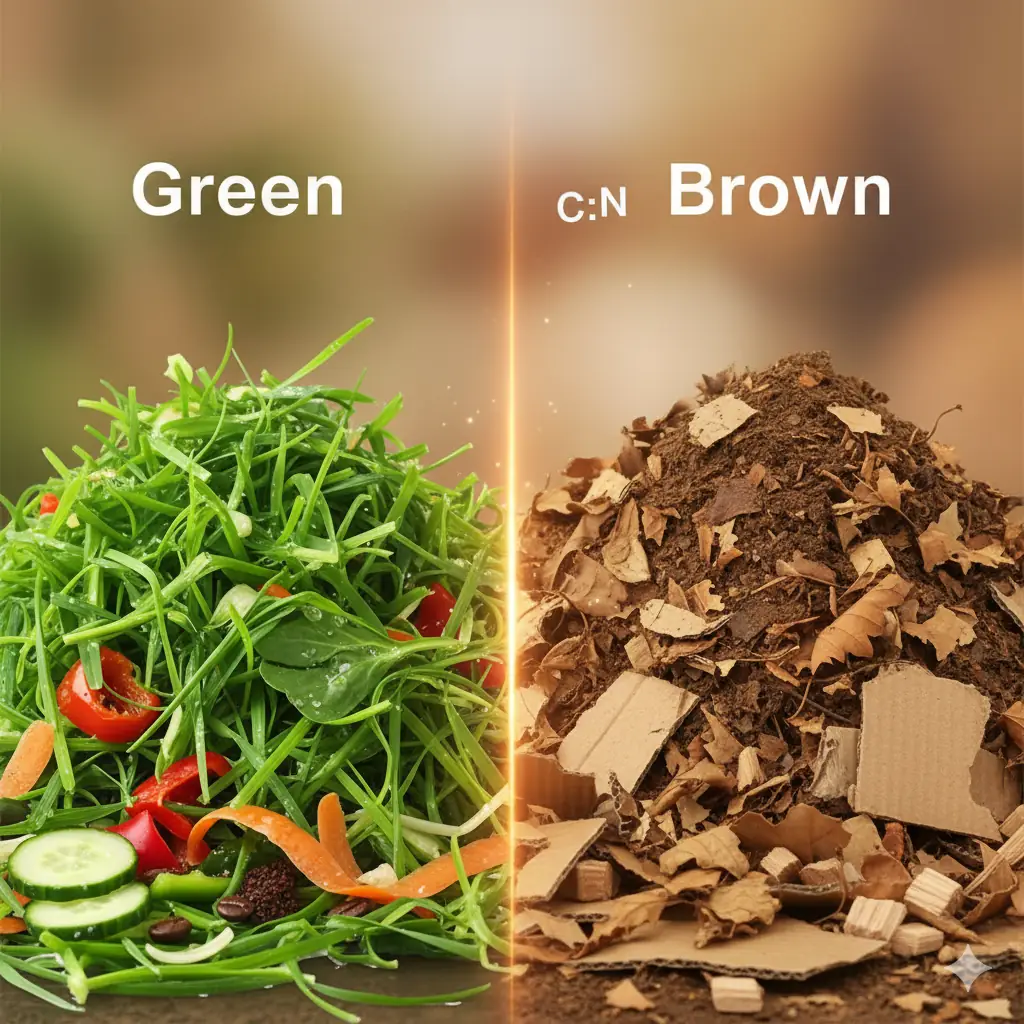

🧪 The Fundamental Equation of Composting
If you’ve spent any time researching composting, you’ve likely come across the terms ‘Greens’ and ‘Browns.’ These aren’t just color descriptors; they are the fundamental building blocks—the yin and yang—of your compost pile.
Understanding the distinction between these two categories is the single most important factor in whether your pile becomes rich, dark compost or a smelly, slow-moving mess. Think of it as knowing the difference between flour and yeast when baking bread.
The entire process relies on feeding microorganisms a balanced diet so they can efficiently break down the raw organic matter. This diet is measured by the Carbon-to-Nitrogen $(\text{C}:\text{N})$ ratio.
🟢 Decoding the ‘Green’ Material: Nitrogen Powerhouses
Green materials are characterized by being high in Nitrogen. Nitrogen is the fuel that powers the composting engine; it’s essential for the growth and reproduction of the microbial armies doing the heavy lifting.
Generally, ‘Greens’ are materials that are fresh, moist, and often still contain some life or were recently living. They break down quickly, releasing heat and vital nutrients into the pile.
The Role of Nitrogen in the Pile
When microbes consume nitrogen-rich material, they use it to build proteins and reproduce rapidly. This biological activity is what generates the intense heat required to accelerate decomposition and, crucially, kill off pathogens and weed seeds.
If your compost pile is too heavy on the Greens, it becomes dense, lacks air, and quickly turns slimy and putrid—a common complaint among new composters. This happens because the rapid breakdown releases nitrogen as smelly ammonia gas instead of retaining it in the pile.
Common Green Material Examples
Here are some of the best everyday examples of nitrogen-rich ‘Green’ materials you can add to your pile:
- Fresh Grass Clippings: Use in moderation, as they can quickly mat together and block airflow.
- Fruit and Vegetable Scraps: Peels, cores, and discarded produce from the kitchen (excluding fats and meats).
- Coffee Grounds and Tea Bags: Surprisingly, these are considered potent nitrogen sources, breaking down quickly.
- Manure: Herbivore manure (like chicken, cow, or horse) is an excellent, heat-generating Green.
- Fresh Weeds: Add before they go to seed.
🍂 Unpacking the ‘Brown’ Material: Carbon Structures
Brown materials are defined by their high Carbon content. Carbon provides the structure, bulk, and energy source for the microbes, and perhaps most importantly, it acts as a necessary absorbent and bulking agent.
Typically, ‘Browns’ are materials that are dry, dead, and woody. They break down much slower than Greens, ensuring the pile maintains necessary porosity and doesn’t collapse into a wet sludge.
The Role of Carbon in the Pile
Carbon serves two vital roles. First, it’s the energy source (like carbohydrates for us) for the microbes. Second, the dry, airy structure of Brown materials creates essential air pockets within the pile.
These air pockets ensure the process remains aerobic (with oxygen), preventing the foul smells associated with anaerobic decomposition. If your pile is too heavy on the Browns, it simply sits there, dry and inert, taking years to decompose.
Common Brown Material Examples
It’s important to always have a readily available stockpile of carbon materials, as you’ll be adding Greens daily:
- Dried Leaves: The ultimate Brown material. Collect and store them in bags during autumn.
- Shredded Cardboard and Paper: Non-glossy, non-colored paper and corrugated cardboard (shredded is essential).
- Wood Chips and Sawdust: Use sparingly and in small quantities, as they take a long time to break down.
- Straw and Hay: Excellent for bulk and aeration, often used in large piles.
- Pine Needles: A good Brown, though they can increase acidity slightly over time.
⚖️ Achieving the Golden Ratio $(\text{C}:\text{N})$
The magic of composting happens when you find the right balance. While the ideal theoretical ratio is around $30:1$ (30 parts Carbon for every 1 part Nitrogen), in practice, keeping things simple works best.
For home composting, a good rule of thumb is to aim for a 50/50 visual mix by volume. That means for every bucket of wet Green scraps you add, you should counter it with a similar sized bucket of fluffy Brown material, such as dried leaves or shredded paper.
✨ Balance Highlight: The Layering Technique
Instead of just dumping materials randomly, try layering them. Start with a thick base of Browns for drainage and airflow. Then, add a thin layer of Greens (e.g., food scraps), and immediately cap that with a layer of Browns. This sandwiching technique contains odors, absorbs moisture, and ensures an even $\text{C}:\text{N}$ distribution as the pile is turned.
🔄 When to Adjust Your Materials
Your compost pile itself will tell you what it needs. You just need to know how to read the signals. Learning these cues is how you move from being a beginner to an intermediate composter.
If the Pile is Sluggish or Cold: Add Greens
A cold pile means the microbes are starving or dormant. They need more nitrogen to heat up and reproduce. A quick addition of fresh grass clippings, coffee grounds, or manure will usually jump-start the heating process within 24 to 48 hours.
If the Pile is Smelly or Wet: Add Browns
A foul, rotten odor, often smelling like ammonia or sewage, indicates too much nitrogen and too little oxygen. This means you need a generous dose of dry, shredded Browns—like cardboard or dry leaves—to absorb the excess moisture and restore proper airflow.
Ultimately, composting is a continuous process of observation and adjustment. By truly understanding the roles of Green and Brown materials, you’re not just throwing things into a bin; you’re actively managing an efficient, natural decomposition factory. This balance is your secret weapon for creating that valuable ‘black gold’ for your garden.