

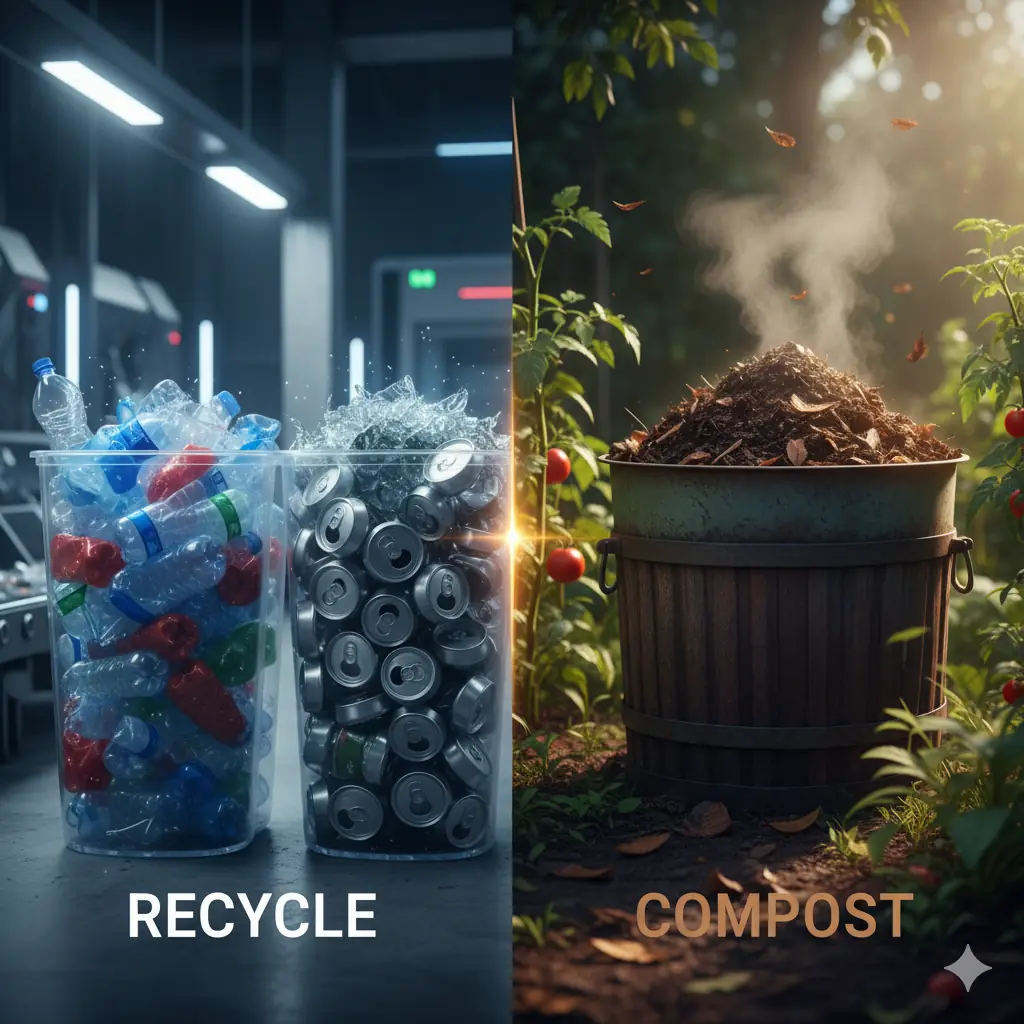

In our daily effort to live more sustainably, we often encounter two powerful concepts: recycling and composting. While both are vital forms of waste diversion, reducing what ends up in landfills, they are fundamentally different processes with distinct goals, methods, and outcomes.
Understanding these differences isn’t just academic; it helps us sort our household waste correctly and maximizes our positive environmental impact. Getting a clear picture of each process is the first step toward becoming a more effective eco-conscious citizen.
♻️ The Fundamentals: Defining the Processes
To begin, let’s establish a clear definition for each practice. Think of them as two separate routes for waste, both leading away from the landfill but toward very different destinations.
What is Recycling?
Recycling is a process where waste materials are collected and converted into new, usable products. It’s an industrial process that involves cleaning, breaking down, and re-manufacturing items like plastics, glass, metals, and paper.
The goal of recycling is to conserve non-renewable resources (like oil used to make new plastic) and reduce the need for raw material extraction. When you recycle an aluminum can, for example, it’s melted down and reborn as another can, potentially saving 95% of the energy needed to make a new one from scratch.
What is Composting?
Composting is a natural, biological process that involves decomposing organic waste materials—such as food scraps, yard trimmings, and paper—into a nutrient-rich soil amendment called compost. This process relies on microorganisms, moisture, and aeration.
The main goal of composting is to stabilize organic matter, return carbon and nutrients to the soil, and avoid the creation of methane gas. Methane is a potent greenhouse gas released when organic materials decompose in the oxygen-starved environment of a landfill.
🔄 Key Differences: What They Handle and Produce
The most significant distinction between recycling and composting lies in the types of materials they accept and the final product they yield. They deal with two completely different categories of waste.
Material Types (Input)
Recycling focuses primarily on inorganic, manufactured materials. These are things that do not easily break down in nature.
- Recycling Input: Glass bottles, aluminum foil, rigid plastic containers (like milk jugs), cardboard boxes, and newspaper. These materials must generally be clean and dry to be processed correctly.
- Composting Input: Banana peels, coffee grounds, eggshells, brown leaves, wood chips, and uncoated paper towels. These are materials that were once living and are biologically degradable.
Imagine a pizza night. The cardboard pizza box is typically composted (if uncoated and greasy), while the plastic soda bottle is recycled. The leftover crusts and toppings are also composted, highlighting how both systems work side-by-side.
The Output and Its Use
The product created by each process is intended for a completely different purpose, serving distinct parts of the economic and natural cycle.
- Recycling Output: Creates a new industrial raw material (e.g., plastic pellets, recycled paper pulp, glass cullet). This output is fed back into manufacturing to create commercial goods.
- Composting Output: Creates compost, a dark, earthy substance. This output is a soil amendment used in gardening, agriculture, and landscaping to improve soil structure, retain water, and feed plants naturally.
Recycling creates new products for sale, supporting a circular economy within the manufacturing sector. Composting creates an ecological input, supporting sustainable agriculture and natural carbon sequestration, closing the loop with nature.
🏭 Process Comparison: Natural vs. Industrial
The environments and mechanisms required for each process couldn’t be more different. One is powered by nature, and the other by machinery and global infrastructure.
The Recycling Infrastructure
Recycling is a complex, capital-intensive logistical chain. It requires high-tech sorting facilities, transportation networks, and specialized factories to handle different material streams efficiently.
The quality of the input is critical; a single contaminant, like a non-recyclable plastic bag in the paper stream, can spoil an entire batch. It is inherently dependent on large-scale infrastructure and market demand for the resulting raw materials, making its success highly sensitive to economic factors.
The Composting Process
Composting, conversely, is a localized and low-tech process. It can be done on a massive commercial scale, but is perfectly achievable right in your backyard or even under your sink with a worm bin (vermicomposting).
The ‘recipe’ is simple: a balance of ‘greens’ (nitrogen-rich food scraps), ‘browns’ (carbon-rich leaves/paper), water, and air. The magic happens naturally as tiny organisms break down the materials into stable humus, a process that requires minimal external energy.
🏡 Making Smart Choices for a Sustainable Home
The goal isn’t to choose one over the other; it’s to integrate both practices effectively into your life. Using both recycling and composting is the gold standard for reducing household waste.
By establishing clear routines and knowing what belongs where, you move beyond just ‘throwing things away’ and adopt a system of resource management. This dual approach maximizes the lifespan and usefulness of everything that passes through your hands.
- Establish Clear Bins: Have clearly labeled bins in your kitchen: one for trash, one for commingled recyclables, and one for compostable scraps. This eliminates confusion and prevents cross-contamination.
- Know Your Local Rules: Recycling rules vary dramatically by location. Check your city’s website to know exactly which plastics (e.g., only #1 and #2) and types of paper are accepted.
- Prioritize Composting: If organic waste (like food scraps) can be composted, always choose that over sending it to the landfill. Composting is often considered a higher form of waste management for organics due to methane avoidance.
- Check the Label: Don’t assume all ‘green’ packaging is compostable. Look for certification logos like the Biodegradable Products Institute (BPI) mark, and only compost items specifically accepted by your local facility (if using a municipal program).
By understanding that recycling and composting are complementary—not competitive—strategies, you can handle your waste stream with confidence and contribute significantly to environmental stewardship. It’s a small commitment that delivers massive returns for the planet and your garden.