

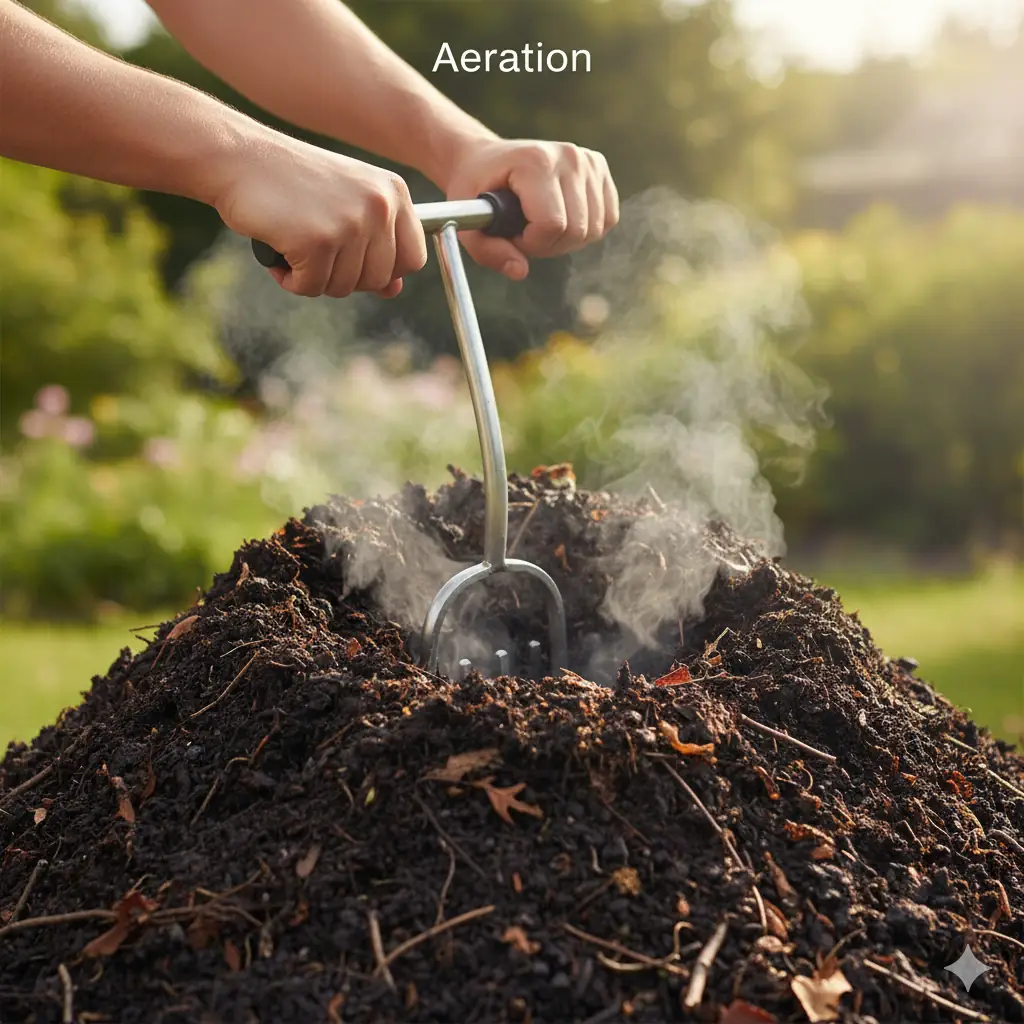

🌬️ Oxygen is Life: Why Air Matters to Your Compost
Composting often seems simple—just mix browns and greens. But to successfully create that rich, dark soil amendment, you rely on billions of tiny workers: aerobic microbes.
These helpful bacteria and fungi are fast, efficient, and their only requirement for doing their job well is a steady supply of oxygen, or air.
When the air supply is cut off, the aerobic microbes die off, and slower, smellier anaerobic (oxygen-hating) bacteria take over. This is when your compost starts sending distress signals.
👃 Signal 1: The Odor Alarms
The single most obvious sign that your pile is struggling with lack of air is a foul odor. A healthy pile smells sweet and earthy, like rich forest soil.
Ammonia Smell
If you catch a whiff of rotten eggs, stale urine, or ammonia, your pile is too dense and lacks oxygen. This often happens when you add too many ‘Greens’ (like grass clippings) without balancing ‘Browns’.
Without oxygen, the nitrogen-rich material can’t break down cleanly, leading to the formation and release of ammonia gas. It’s the pile shouting, ‘I’m suffocating!’
Sour or Rancid Smell
A sour, vinegary, or rancid aroma often means the pile is too wet *and* compacted. The lack of air causes organic materials to ferment, similar to pickles or wine, which is not what you want in your compost.
This smell is a strong indicator that the moisture levels are too high and the structure is too tight, preventing gases from escaping and new air from entering.
🌡️ Signal 2: The Temperature Drop
The entire point of hot composting is to utilize the heat generated by those hardworking aerobic microbes. When they run out of air, they can’t work, and the temperature plummets.
Cold and Inert
If your compost pile was warm to the touch last week but is now cold, it’s a major sign of inactivity. The microbes have burned through the oxygen in the core and paused their feeding frenzy.
This signals that the critical heating cycle has been interrupted. Your pile is still decomposing, but at a glacial, cold-composting pace.
Micro-Case Example: If you feel the outside of your tumbler bin and it’s cold, but you know you added a large batch of fresh kitchen scraps yesterday, the immediate drop in heat indicates a blockage—likely compaction cutting off oxygen to the core.
🧱 Signal 3: Physical Consistency and Density
Sometimes you don’t even need to smell or touch the pile—you can see and feel the problem when you try to turn it.
Heavy and Compacted
If the material feels heavy, dense, and difficult to lift or turn, it’s too compacted. This density eliminates all the necessary air pockets that should exist between the ‘Browns’.
Wet, dense materials like food sludge or large amounts of fresh grass clippings are the primary culprits here. They cling together, forming a solid, anaerobic mass.
Slime or Waterlogging
When you turn the material, look for wet, slimy patches or actual standing water at the bottom of the bin. This is definite proof of excessive moisture and zero airflow.
Waterlogging is a double blow: it fills the spaces where air should be and encourages those smelly anaerobic bacteria to flourish.
🛠️ The Solution: Restoring Airflow Quickly
The great news is that fixing a compost pile that needs air is relatively straightforward and effective. You need to aerate and rebalance simultaneously.
1. The Full Turn
The simplest and most effective solution is a complete turning. Use a compost fork or pitchfork to completely flip the pile from the outside edges to the center, and vice-versa.
This action mechanically breaks up compaction and infuses the entire pile with fresh oxygen, essentially hitting the ‘reset’ button for your microbial workers.
2. Add Bulking Agents
As you turn the dense material, mix in coarse, dry ‘Browns’ that will resist compaction and create permanent air channels. These are known as bulking agents.
Excellent choices include wood chips, shredded corn stalks, or small twigs. They act as internal structural supports, ensuring air can circulate even when the Greens break down and settle.
3. Balance the Moisture
If the pile is too wet, add even more dry, absorbent ‘Browns’ like sawdust or shredded cardboard while turning. These materials soak up the excess liquid and restore that ideal, wrung-out sponge consistency.
Note: When using compost tumblers, ensure you are turning them several times a week, especially after adding a large batch of wet food scraps. Tumblers are easy to use but often need more frequent rotation than people assume.
🎯 Prevention is the Best Medicine
Regular aeration is the easiest habit to adopt to prevent future issues. Aim to turn your pile once a week, or at least every time you add a large volume of nitrogen-rich ‘Greens’.
By learning to recognize the telltale signs—smell, temperature, and texture—you can keep your compost pile breathing happily, ensuring a continuous supply of rich, odorless soil amendment.