

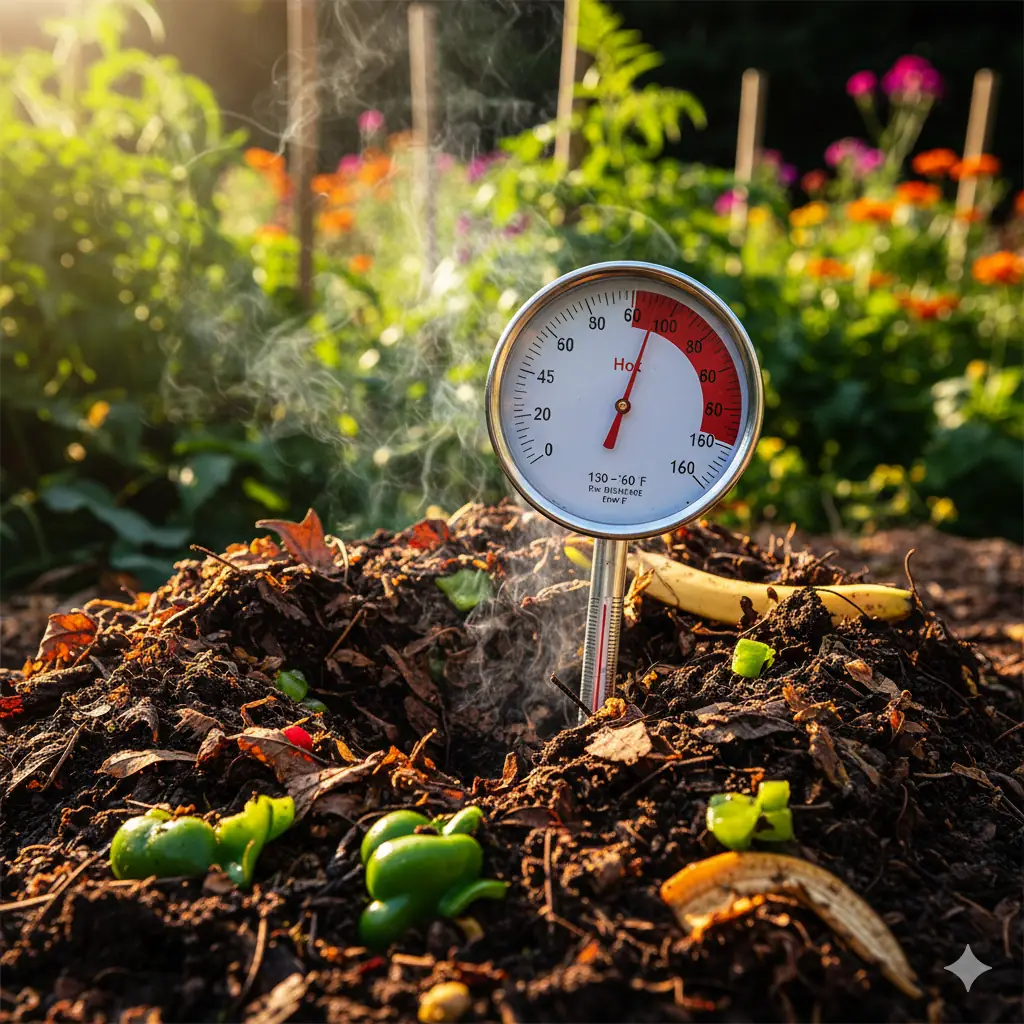

🔥 The Hidden Engine: Why Temperature is Composting’s Accelerator
Ever wonder why some compost piles seem to magically transform waste into rich soil in weeks, while others sit stagnant for months? The answer often lies with one critical, invisible factor: temperature.
Composting isn’t just about throwing scraps into a pile; it’s about creating the perfect environment for billions of tiny microbes to thrive. And just like us, these microbes have an ideal temperature range where they perform their best work.
Understanding how temperature influences this intricate process is key to moving beyond ‘cold composting’ to a faster, more efficient system that yields ‘black gold’ much more quickly.
🔬 The Science of Heat: Microbes at Work
Heat in a compost pile isn’t from the sun; it’s generated by the microscopic organisms themselves. As bacteria and fungi break down organic matter, they release energy in the form of heat, much like our bodies do when we exercise.
The Three Temperature Phases:
- Mesophilic Phase (Cool): 50–90°F (10–32°C). This is the initial stage, where common microbes begin the breakdown. Slow decomposition, but it gets the process started.
- Thermophilic Phase (Hot): 113–160°F (45–71°C). This is the ‘working’ phase, where specialized heat-loving bacteria rapidly decompose materials. This is where the magic happens!
- Cooling Phase: As easily digestible materials are consumed, the pile cools down, and mesophilic microbes finish the job.
⏱️ Hot vs. Cold: Understanding the Speed Difference
The biggest distinction in composting speed comes down to whether your pile consistently reaches the thermophilic (hot) phase or remains in the mesophilic (cool) phase.
Cold Composting (Slow & Steady)
This is a passive method, often seen as a simple pile where materials are added over time without much management. The temperatures remain low, typically below 90°F (32°C).
- Pros: Requires minimal effort.
- Cons: Very slow (can take 6 months to 2 years); won’t kill weed seeds or pathogens; can attract pests if not managed carefully.
Hot Composting (Fast & Furious)
This is an active method, aiming to consistently hit 130–160°F (54–71°C). This high heat significantly speeds up decomposition, often yielding finished compost in 1–3 months.
- Pros: Rapid decomposition; kills most weed seeds and pathogens; reduces odor and pest issues.
- Cons: Requires more attention (turning, monitoring C:N and moisture).
📈 How to Get Your Pile Hot (and Keep It There)
If you want faster compost, you need to provide the ideal conditions for those heat-loving thermophilic microbes.
1. Build a Critical Mass
A pile that’s too small (less than 3 feet by 3 feet by 3 feet) can’t generate or retain enough heat. Aim for a substantial volume to create an insulated core.
Think of it like a bonfire; a few twigs won’t generate much heat, but a big pile of logs certainly will.
2. Balance Your Greens and Browns
The right Carbon-to-Nitrogen (C:N) ratio (around 30:1) is crucial. ‘Greens’ (nitrogen-rich items like fresh grass and food scraps) provide the fast fuel, while ‘Browns’ (carbon-rich items like dry leaves and paper) provide energy and structure.
Too many Greens and it will go smelly; too many Browns and it will be too slow and cold.
3. Maintain Optimal Moisture
The pile should feel like a wrung-out sponge. Too dry, and microbial activity ceases. Too wet, and oxygen is excluded, leading to anaerobic (cold, smelly) decomposition.
Water a dry pile thoroughly while turning; add dry Browns to a wet pile to absorb excess moisture.
4. Turn Regularly
Turning introduces vital oxygen, which fuels the aerobic, heat-producing microbes. When the temperature drops, it’s a sign that the oxygen has been depleted, and it’s time to turn.
Ideally, turn a hot pile every 3–7 days to keep the heat cycle going. Use a compost thermometer to monitor the temperature and guide your turning schedule.
Example: If your thermometer reads 150°F and then drops to 100°F after 3 days, it’s time to turn! The temperature will likely spike again within 24 hours.
🥶 External Factors: Weather’s Influence
While internal management is key, external temperatures do play a role. Cold winter weather will naturally slow down a compost pile, making it harder to maintain high thermophilic temperatures.
Conversely, hot summer weather can accelerate decomposition but also cause piles to dry out faster, requiring more frequent watering.
🎉 The Rewards of a Hot Pile
Taking the extra steps to maintain a hot compost pile is incredibly rewarding. You’ll get finished compost faster, capable of killing weed seeds and pathogens, and with fewer problems like pests or odors.
By becoming a temperature expert, you become a true compost master, transforming waste efficiently into a valuable resource for your garden.