

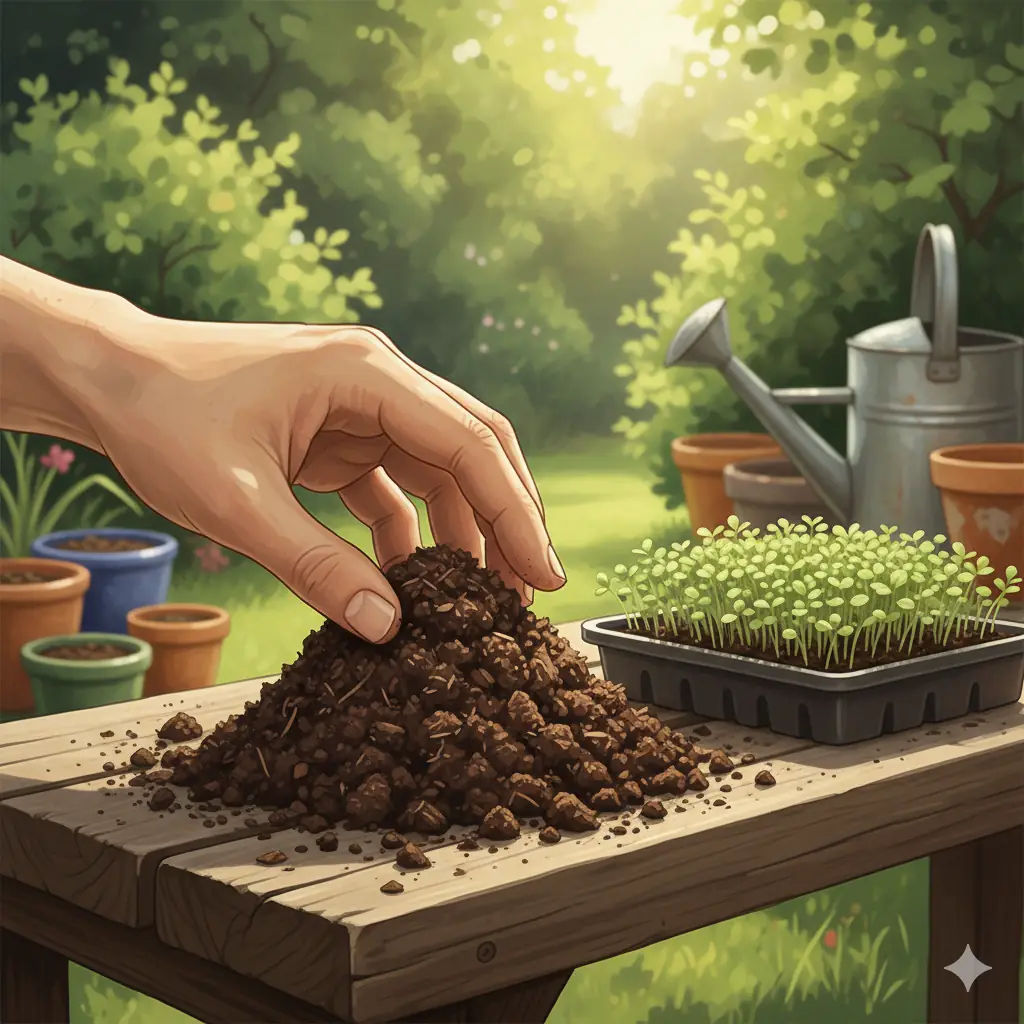

There’s a special kind of pride that comes with nurturing your own compost pile. It’s like brewing the perfect cup of coffee—you’re transforming humble ingredients into something rich and essential. But once you’ve done all that work, how do you really know if your ‘black gold’ is ready to enrich your garden?
It turns out that checking your compost’s quality doesn’t require a laboratory or a PhD. You can use simple, human-centered tests right in your backyard. Think of these methods as your quick quality control checks to ensure your soil gets the five-star nutrition it deserves. Let’s dig into the practical steps!
Design Highlight: The Visual Cue Test
One of the most satisfying indicators of great compost is its appearance. It should be dark, crumbly, and uniform—less like yesterday’s leftovers and more like rich, dark chocolate cake crumbs. If it looks right, you’re halfway there!
The Sensory Check: Seeing, Smelling, and Touching
Before you get technical, engage your senses. Your eyes, nose, and hands are the first and most immediate tools you have for assessing compost quality. This first-hand inspection is often the most telling.
The Visual Test: Looking for Uniformity
Good compost should have a wonderfully uniform texture. You shouldn’t be able to easily identify the original materials—gone should be the banana peels, the large wood chips, or the distinct eggshells. Instead, you should see a fine, dark, earth-like substance.
If you still see recognizable food scraps or chunks of undecomposed matter, your compost needs more time to “cook.” It’s still a work in progress, like dough that hasn’t fully risen; patience is key to letting the microbes finish their amazing work.
The Smell Test: An Earthy Aroma
Quality compost should smell like a forest floor after a gentle rain—sweet and earthy. This pleasant aroma indicates a healthy, aerobic decomposition process.
If your compost smells foul, sour, or like rotten eggs, it’s likely gone anaerobic—meaning it lacks oxygen. This calls for turning the pile more frequently to introduce air and get those good microbes breathing again!
The Touch Test: Texture and Temperature
Pick up a handful and feel it. Great compost should be cool to the touch (unless it was just turned, in which case it might be slightly warm from microbial activity) and feel crumbly, light, and airy. It shouldn’t be slimy or compacted.
Squeeze a handful: it should hold its shape slightly, like a wrung-out sponge, but crumble easily when poked. If water streams out, it’s too wet; if it feels dusty, it’s too dry. Aim for that perfect middle ground—moist but not soaked.
The Practical Tests: Seedlings and Stability
Sensory checks are great, but the proof of the pudding is in the planting! These next tests are designed to see how the compost actually performs, ensuring it won’t harm your precious seedlings, which are quite sensitive to unfinished material.
The Germination Test (Cress Test)
This is arguably the most reliable home test. Unfinished compost can contain high levels of organic acids or salts that inhibit plant growth, a phenomenon known as phytotoxicity. The Germination Test ensures your compost is mature and stable.
To perform this, fill two small containers: one with your compost and one with a known good growing medium (like potting soil) as a control. Plant about ten fast-growing seeds, like radish or cress, in each container, ensuring both are kept equally moist and in the same light conditions.
After about a week, compare the results. If the seeds in the compost sprout as quickly and grow as robustly as those in the control soil, you have successfully produced stable, high-quality compost. If the compost seeds are stunted or don’t germinate well, it needs more curing time.
$$
\text{Compost Maturity Index} = \frac{\text{Number of Seeds Germinated in Compost}}{\text{Number of Seeds Germinated in Control Soil}} \times 100
$$
A score near 100% or higher is what you’re aiming for, proving your compost is a safe and welcoming home for new life.
For example, if eight cress seeds sprouted in the compost and ten sprouted in the potting soil, your score is 80%. This is okay, but it suggests the compost is still a little “hot” (not fully mature) and might be best mixed with other soil before use.
The Bag Test: A Quick Peek at Stability
This test offers a shortcut to checking for residual decomposition activity. Take a small, clear plastic bag (a Ziploc works well) and fill it about halfway with your finished compost. Seal it up and leave it in a warm spot, like a sunny window.
Over a few days, observe the inside of the bag. If you see significant moisture buildup, or if the compost begins to smell foul, it means the material is still actively decomposing and releasing gases and heat. If it remains relatively dry, odorless, and stable, it’s likely ready for the garden.
Comparing Compost with the Right Stuff
It helps to know what finished compost is not, compared to its ingredients and its final destination—the soil. This mental comparison helps you appreciate the transformation that has taken place.
- Unfinished Compost: Looks like a mix of food scraps and yard waste. Smells sour or ammonia-like. Feels hot and chunky.
- Finished Compost: Looks like rich, dark, fine soil. Smells sweet and earthy. Feels cool, crumbly, and light.
- Garden Soil: Can be heavy, clay-like, or sandy. Compost is added to it to improve its structure, water retention, and nutrient profile.
This final product, your high-quality compost, acts like a magnificent sponge, holding water and nutrients for your plants while aerating the soil like a tiny fleet of subterranean bulldozers. It’s the ultimate soil conditioner.
Micro-Case Example: Sarah’s Speedy Solution: Sarah, a novice gardener, noticed her cucumber seedlings were struggling. She performed the Germination Test and found her compost only scored 60%. Instead of starting over, she mixed the ‘hot’ compost with a 50/50 blend of aged manure and coir. A month later, the blend was perfect, and her cucumbers took off, teaching her the value of patience and blending.
Addressing the “Hot” Compost Issue
The term “hot compost” simply refers to material that is still actively decomposing. While this is great for killing pathogens and weed seeds inside the pile, it can be detrimental when applied directly to delicate plant roots.
Immature compost robs nitrogen from the soil as the microbes race to finish breaking down the remaining carbon materials. This phenomenon, known as nitrogen immobilization, essentially starves your plants of a crucial nutrient, ironically making your soil less fertile initially.
This is why that final step of “curing” or letting the pile rest and cool is so vital. It’s the finishing touch, like letting a complex sauce simmer down and meld all its flavors. Once it passes the Germination Test, you know the microbial activity has stabilized and the compost is ready to nourish, not compete with, your plants.
Achieving great compost is a journey of partnership with nature. By using these simple, insightful home tests, you take control of the quality, transforming your kitchen scraps into a potent, life-giving resource for your garden. Happy composting!