

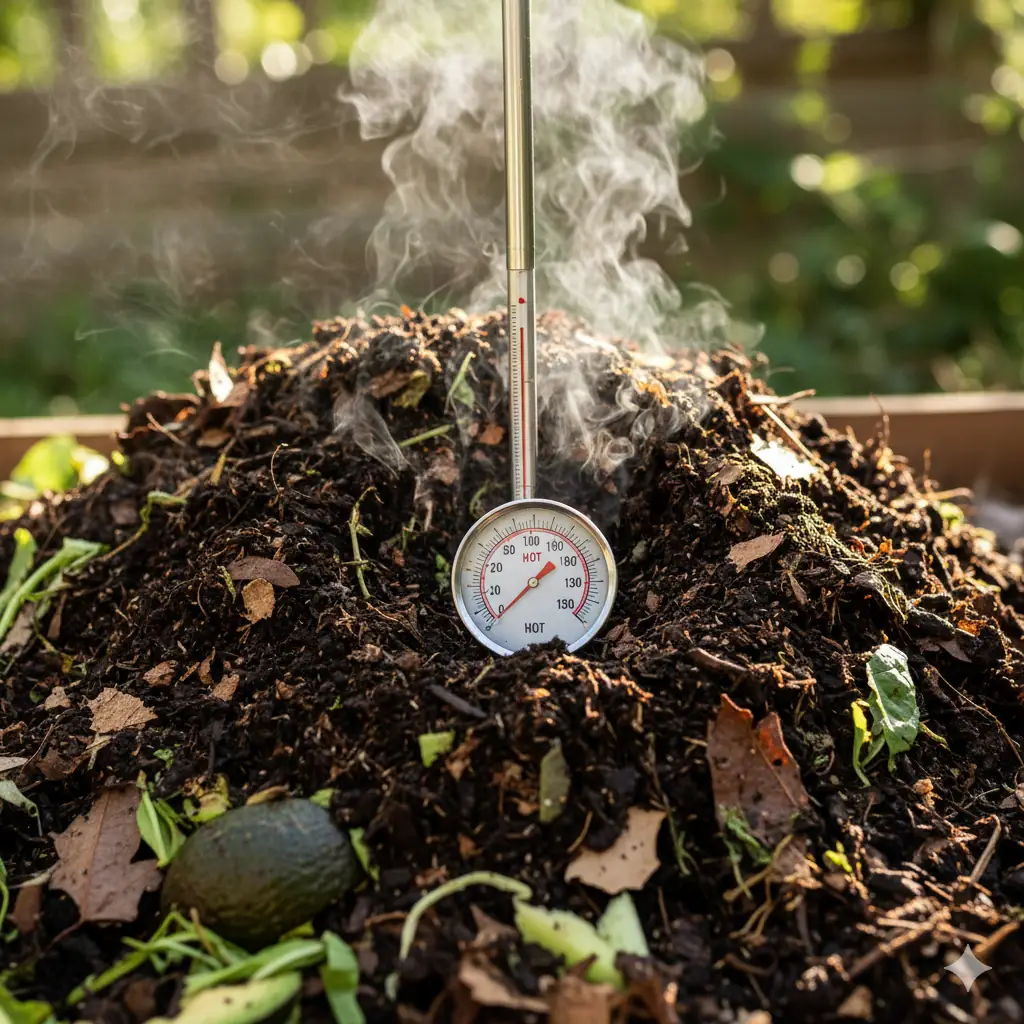

♨️ What Makes ‘Hot’ Composting Different?
Composting, at its core, is a natural breakdown process. But ‘hot composting’ is a method designed to significantly accelerate that process, often producing finished compost in a matter of weeks rather than months or years.
This rapid decomposition is achieved by creating an optimal environment for thermophilic (heat-loving) bacteria. These microbes work so vigorously that they raise the internal temperature of the pile to between $130^{\circ}\text{F}$ and $160^{\circ}\text{F}$ ($54^{\circ}\text{C}$ to $71^{\circ}\text{C}$).
This high heat is the key benefit, as it sterilizes the compost, killing off most weed seeds and harmful pathogens that might survive in a cooler, passive pile. It’s like using a controlled biological oven.
Achieving and maintaining this temperature requires attention to detail, but with a few simple techniques, you can successfully harness this powerful natural heat.
📏 Building the Foundation: Size and Structure
The size and construction of your pile are the first critical steps for successful hot composting. If your pile is too small, it will quickly lose heat to the surrounding air.
The Minimum Mass Requirement
To retain enough heat for thermophilic activity, the compost pile needs to reach a certain volume threshold. Generally, the ideal minimum size is a cube measuring approximately 3 feet by 3 feet by 3 feet (or about 1 cubic meter).
This mass provides the necessary insulation to allow the microbial heat generated in the center to build up. Think of it as wrapping yourself in a thick blanket—smaller piles just don’t offer enough coverage.
Ideal Container Choices
While an open heap can work, a contained system helps maintain shape and temperature. Three-sided bins, constructed from materials like wooden pallets or heavy wire mesh, are excellent choices.
If you prefer less manual labor, large, insulated compost tumblers designed for rapid turning can also achieve hot temperatures, provided they are filled sufficiently.
⚖️ The Golden Rule: Achieving the Correct C:N Ratio
The Carbon-to-Nitrogen ($ ext{C}: ext{N}$) ratio is the most scientific part of hot composting. Nitrogen (Greens) provides the fuel for microbial growth, while Carbon (Browns) provides the bulk and energy source.
Targeting the $30:1$ Balance
The theoretical ideal ratio for rapid decomposition is $30:1$ by weight. However, for the home composter, measuring by weight is impractical. Instead, aim for a visual ratio of roughly two parts Brown material for every one part Green material by volume.
For example, a wheelbarrow of shredded dry leaves (Browns) should be mixed with half a wheelbarrow of fresh grass clippings and food scraps (Greens). Getting this ratio right is the difference between an active, hot pile and a dormant, cool one.
Pro Tip: Always have a stockpile of dry, shredded Brown materials on hand (like dry leaves or cardboard) to immediately balance any wet, nitrogen-heavy additions like kitchen scraps.
💧 Mastering Moisture and Particle Size
Two often-overlooked factors—water and the size of your ingredients—can dramatically impact the speed and success of your hot composting efforts.
The Wrung-Out Sponge Test
Microbes need water to thrive, but too much water will displace air, leading to anaerobic conditions and smell. Your pile should be consistently damp, similar to a wrung-out sponge—it holds moisture but doesn’t drip excessively.
If your pile looks dry, wet it thoroughly while turning. If it looks soggy, add more dry Browns to absorb the excess moisture. This is a constant balance you must manage.
Pre-Shredding Materials
The speed of decomposition is proportional to the surface area available for the microbes to attack. Large items break down slowly, while small items decompose quickly.
Make it a habit to chop, shred, or cut all materials—especially woody pieces and thick vegetable scraps—into small pieces, ideally no larger than one or two inches. This single step will shave weeks off the composting time.
💨 The Critical Step: Aeration and Turning
Once your pile is built with the correct ingredients and moisture, the next step is managing the heat and air. This is where active effort pays the highest dividends.
Monitoring the Temperature Spike
A long-stemmed compost thermometer is not optional for hot composting—it’s essential. Insert it deep into the center of the pile and monitor it daily. A healthy pile should hit the target temperature range within 24 to 72 hours after being built or turned.
The Turning Schedule
The golden rule for turning a hot pile is to turn it whenever the temperature begins to drop below $130^{\circ}\text{F}$. This drop signals that the readily available oxygen has been consumed by the microbes.
For most successful hot piles, this translates to turning every three to five days. A complete turn means moving the material from the cold outside edges and placing it right into the hot center, ensuring all material is processed uniformly.
🔥 Quick Hot Composting Checklist
To ensure your pile is built for speed, confirm these details before mixing:
- Pile Volume: $\geq 1$ cubic meter.
- Particle Size: All pieces are $< 2$ inches.
- Moisture Level: Feels like a wrung-out sponge.
- Initial Mix Ratio: Visually 2 parts Browns to 1 part Greens.
🛑 Troubleshooting Common Hot Composting Issues
Even with careful planning, things can sometimes go sideways. Learning to diagnose the problem is part of the mastery.
If the pile is Smelly and Slimy: This means too much Nitrogen/Greens and not enough oxygen. Solution: Turn immediately and add a large quantity of dry, shredded Brown material.
If the pile is Cold and Dry: This indicates insufficient moisture or Nitrogen to fuel the microbes. Solution: Add water, turn, and incorporate a fresh batch of potent Greens like coffee grounds or manure.
If the pile is Hot at First, then Cools Permanently: You’ve likely run out of easily digestible material. Solution: Add a fresh layer of new Greens and Browns, ensure proper moisture, and turn vigorously to restart the heating cycle.
Hot composting requires commitment, but the reward is high-quality, safe, and weed-free compost in a fraction of the time. By focusing on the $ ext{C}: ext{N}$ ratio, maintaining moisture, and providing constant oxygen, you transform a chore into a highly productive process.